How Much Fuel Does a Boeing 747 Hold?
Boeing 747 usable fuel capacity ranges from 48,445 US gallons on a representative 747-100 to 63,240 US gallons on a two-body-tank 747-400ER; tank arrangement varies by variant.
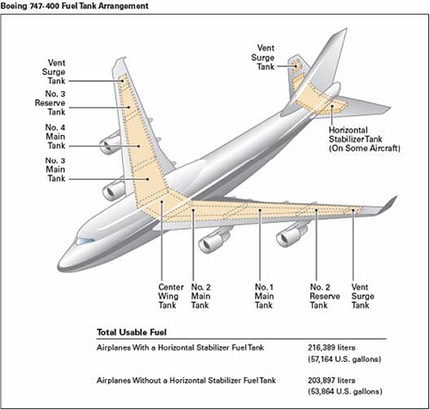
The Boeing 747 fuel system is not simply a collection of large tanks. It is a load-management system, an engine-feed system, a refuelling network, a balance-control system and - on many variants - a fuel-jettison system. Its job is to deliver uninterrupted fuel to four engines while keeping the aeroplane within structural and centre-of-gravity limits.
The architecture evolved from the flight-engineer-controlled 747-100 to the computer-assisted 747-400 and 747-8, but the basic idea remained remarkably consistent: most fuel is carried in the wing, four main tanks are associated with four engines, and a crossfeed manifold provides redundancy and flexibility.
Short answer: a 747 normally uses centre fuel before progressing toward one main tank feeding each engine. Transfer systems move reserve or auxiliary fuel into usable feed tanks, while crossfeed valves allow the crew or automatic logic to change which tanks supply which engines.
On this page
- Fuel-system diagrams
- Tank layout and structure
- How fuel reaches the engines
- Transfer, balance and trim
- Refuelling, defuelling and venting
- Fuel jettison
- Fuel quantity and cockpit controls
- Fuel capacity by 747 variant
- What changed on every major variant
- Fuel-tank safety after TWA 800
- Videos
- Frequently asked questions
Visual system guide
How fuel is stored, fed and transferred
These simplified diagrams show the common 747 architecture. Exact tank names, capacities, controls and automatic logic vary by model and airline configuration.
Typical long-range fuel-use sequence
- Centre fuel firstHigh-pressure centre pumps supply the manifold.
- Inboard mains reduceTanks 2 and 3 are managed toward the outboard tank quantities.
- Reserve fuel transfersReserve fuel moves into the associated mains when commanded.
- Tank-to-engine feedEach main tank normally finishes feeding its numbered engine.
This is a learning summary, not an operating procedure. Thresholds and automation differ between the classic 747, 747-400 and 747-8, and approved aircraft manuals always govern.
Fuel tank layout and structure
The 747's principal fuel tanks are integral tanks. Their walls are not removable metal containers inside the wing; the sealed wing structure itself forms the tank. Ribs and spars divide that volume into bays, while access panels allow inspection and maintenance.
The common 747 arrangement includes:
- Four main tanks, numbered 1 to 4 from left to right, broadly aligned with engines 1 to 4.
- A centre wing tank (CWT) in the wing centre section through the fuselage.
- Reserve tanks in the outboard wing region. Naming differs between generations, but their function is to transfer fuel into the main-tank system rather than feed an engine directly.
- Two surge tanks near the wing tips. These are vent collectors, not normal mission-fuel tanks.
- Optional or model-specific auxiliary tanks, including horizontal-stabilizer fuel on some 747-400 passenger configurations and cargo-hold body tanks on the 747-400ER.
Why carry the fuel in the wing?
Putting fuel in the wing saves the weight of separate tank shells and places a large part of the aircraft's mass close to where lift is produced. In flight, lift bends the wings upward. Fuel weight distributed along the wing acts downward and reduces the bending moment at the wing root.
That structural benefit influences the burn schedule. Centre-tank fuel is normally used early, while outboard wing fuel is retained longer. This is why "burn the centre first" is more than a plumbing convenience: it is part of managing airframe loads.
Main tanks 2 and 3 are the large inboard tanks
The two inboard main tanks contain considerably more fuel than the outboard main tanks 1 and 4. After the centre tank is depleted, 747 fuel logic manages tanks 2 and 3 toward the quantities in tanks 1 and 4. The system can then settle into tank-to-engine feed, with each engine supplied by its corresponding main tank.
What the surge tanks actually do
Every tank needs to breathe as fuel volume and air pressure change. Vent lines lead toward surge tanks near the tips. Fuel that reaches a vent line because of thermal expansion, manoeuvring or overfill can collect there and drain back rather than immediately leaving the aircraft.
The surge tanks vent to atmosphere through outlets designed to maintain suitable pressure over the flight envelope. They are therefore part of both spill control and pressure management.
How fuel reaches the engines
Main-tank boost pumps
In the original 747 arrangement, each main tank had two electrically powered centrifugal boost pumps connected in parallel. Either pump could provide the required flow, and a bypass path allowed the engine-driven pump to draw fuel if both boost pumps in that tank were unavailable.
The four main-tank feed lines connect to a crossfeed manifold through valves. In the simplest normal condition, main tank 1 feeds engine 1, main tank 2 feeds engine 2, and so on. Opening the appropriate crossfeed valves creates many other combinations, which is valuable after a pump, engine or tank-feed problem.
Why centre fuel takes priority
The centre wing tank uses override/jettison pumps with a higher discharge pressure than the main-tank boost pumps. With the centre pumps operating and the feed valves correctly configured, their pressure "overrides" the main pumps at the common manifold. The engines consume centre fuel even though the main pumps remain available.
That pressure hierarchy is an elegant form of hydraulic logic: the preferred tank wins without needing to shut down every backup source. Check valves prevent unwanted reverse flow.
Crossfeed is flexibility, not one giant tank
The interconnected manifold does not mean all tanks constantly mix. Motor-operated valves and check valves establish the active paths. The system can isolate a side, balance fuel across the aircraft or allow one tank to feed multiple engines, but the crew must still respect pump inlet coverage, lateral balance and structural limits.
Transfer, balance and trim
Reserve-tank transfer
Reserve tanks are emptied into associated main tanks. Depending on the variant, transfer valves are opened by crew action or system logic once main-tank quantities reach defined conditions. Gravity and pressure relationships then move the fuel inboard, where it enters the normal engine-feed sequence.
The word "reserve" can be misleading: these are not the regulatory contingency reserves shown on a flight plan. They are physical tanks. Whether the fuel inside them is trip fuel, contingency fuel or final reserve is an operational planning matter.
Horizontal-stabilizer fuel
Some long-range 747-400 passenger configurations could carry about 3,300 US gallons in the horizontal stabilizer. Tail fuel increased capacity and could place the centre of gravity farther aft, reducing the aerodynamic download required from the tail and therefore reducing trim drag.
The trade-off was additional pumps, valves, plumbing, control logic and maintenance requirements. Fuel had to be transferred forward according to a controlled schedule. The system was not fitted or active on every 747-400: FAA material specifically distinguishes the 747-400D and 747-400F, which did not have an active horizontal-stabilizer tank.
747-400ER body tanks
The passenger 747-400ER could add one or two auxiliary body tanks in the forward lower cargo compartment. Boeing's December 2024 planning manual lists each tank at 3,060 US gallons (11,582 L). With two installed, some lower-hold cargo volume was exchanged for longer range or greater payload-range flexibility.
These were separate tanks, not an enlargement of the centre wing tank. Their fuel was transferred into the main system before being delivered to the engines. The 747-400ERF used the same basic extended-range idea in a purpose-built freighter.
Lateral balance
A four-engine aircraft can develop a fuel imbalance because of pump selection, an engine shutdown, a leak or unequal transfer. Crossfeed and pump control allow fuel to be consumed from the heavier side. The objective is not simply equal gauge readings; crews follow model-specific limits and checklists so that any suspected leak is not accidentally fed from another tank.
Refuelling, defuelling and venting
Pressure refuelling
A 747 can accept fuel through underwing pressure-fuelling receptacles. Fuel enters a common refuel/jettison manifold, and selected refuel valves distribute it to the required tanks. The fuelling station lets ground staff select tanks and monitor quantities without filling each tank through an individual overwing cap.
Float-operated or electrically controlled shutoff features protect against overfill. Vent and surge capacity is still essential because fuel entering at high flow rates displaces a large volume of air. Boeing's first 747 fuel-system paper devoted substantial attention to pressure surges and static electricity because the aircraft's size made high-rate refuelling a new engineering problem.
Why wing tanks are filled before the centre tank
Loading instructions are configuration-specific, but the structural principle is consistent: wing fuel helps relieve upward wing bending. FAA material on the 747-100 describes the wing tanks being filled before additional mission fuel is put in the centre wing tank.
Defuelling and fuel transfer on the ground
The manifold can also support defuelling or tank-to-tank transfer when valves and pumps are selected for an approved maintenance or ground-handling procedure. This common plumbing reduces the amount of dedicated pipework, but it makes valve position and pump operation critically important.
Fuel jettison
The 747 can depart at a weight far above its maximum landing weight. If it must return soon after takeoff, the crew may hold to burn fuel, land overweight using an approved procedure, or jettison fuel when conditions and time permit. Dumping is therefore an option, not an automatic requirement.
During jettison, pumps route fuel into the jettison manifold and through outlets near the wing tips. Locating the nozzles outboard helps the discharge clear the engines, fuselage and tail. Later 747s provide a fuel-to-remain selection and system logic to help stop jettison near the desired quantity; classic aircraft relied more heavily on the flight engineer and direct panel indications.
Fuel released at altitude forms a fine spray. How much evaporates or disperses depends on release height, temperature, droplet size and weather, so it is more accurate to say that fuel can disperse substantially than to claim it always evaporates before reaching the surface. Crews coordinate with air traffic control and use designated procedures whenever the emergency allows.
Fuel quantity and cockpit controls
Measuring fuel by capacitance
Fuel-quantity indication systems use multiple electrical probes distributed through tanks. The capacitance changes as the probes become covered or uncovered by fuel. Because tank shape is irregular and fuel density changes, the indicating system converts many measurements into a usable mass or quantity display rather than relying on a simple float.
No sensor arrangement can make every pocket of fuel usable. Small quantities remain below pump inlets or trapped by structure, which is why documents distinguish total, usable and unusable fuel.
From flight engineer to EICAS
On the 747-100, -200, -300 and SP, the flight engineer managed the fuel panel, pump switches, crossfeed and transfer schedule. The two-crew 747-400 moved monitoring to the pilots, added an EICAS fuel synoptic and used fuel-system management cards to automate or prompt much of the sequence.
The 747-8 continued the two-pilot philosophy with updated displays and control logic. Automation reduces workload, but the same physical concerns remain underneath: pump pressure, valve position, tank quantity, balance, temperature and feed continuity.
Fuel temperature
Jet fuel cools during long, high-altitude flight. The crew monitors fuel temperature against the approved limit for the fuel specification in use. The operational response may involve changing altitude, speed or route to reach warmer air; the correct action comes from the aircraft flight manual and airline procedures, not a generic rule of thumb.
Fuel capacity by Boeing 747 variant
Published capacities vary with engine installation, optional tanks, weight standard and even the definition used in a particular document. The table therefore gives representative Boeing usable or published capacity figures, not a universal loading limit for every individual airframe.
| Variant or configuration | Representative capacity | What changes |
|---|---|---|
| 747-100 passenger | 48,445 US gal (183,380 L) | Boeing's later performance summary; an early system paper described a 47,210-gallon configuration |
| 747SP passenger | 50,359 US gal (190,620 L) | Shorter fuselage, long-range mission; classic seven-tank architecture |
| 747-200B passenger | 53,985 US gal (204,355 L) | Higher-capacity development of the classic 747 |
| 747-300 passenger | 53,985 US gal (204,355 L) | Similar published capacity to the representative -200B |
| 747-400 family | about 53,985 - 57,285 US gal | Configuration-dependent; Boeing's upper figure includes optional 3,300-gallon tail fuel |
| 747-400ER, GE engines | 63,240 US gal (239,389 L) | Includes two 3,060-gallon body tanks |
| 747-400ER, PW or RR engines | 63,460 US gal (240,222 L) | Boeing lists a slightly different installation figure |
| 747-8 Intercontinental | 59,734 - 63,034 US gal (226,113 - 238,609 L) | Boeing Revision E conflicts: its detailed tank table lists 59,734 with no tail fuel, while page 2-3 lists 63,034 including tail-tank volume |
| 747-8 Freighter | 59,734 US gal (226,113 L) | Same published total, with no tail tank |
Boeing's January 2026 747-8 manual contains a source discrepancy worth preserving: its passenger general-characteristics page gives 63,034 US gallons including tail-tank volume, while the later detailed tank-capacity table gives 59,734 US gallons and a dash for the horizontal stabilizer. Those figures differ by exactly 3,300 gallons. Until Boeing reconciles the tables, this page reports both with their configuration basis instead of treating either as universal.
The apparent oddity - an extended-range 747-400ER carrying more published fuel than even the upper 747-8 passenger figure - is real in Boeing's planning tables. "Extended range" and "newer" do not mean "largest fuel volume." The 747-8's new wing, GEnx engines, aerodynamics, weights and payload-range design changed the whole efficiency equation.
747 fuel capacity converter
Convert between US gallons, litres and Jet A weight, then compare the result with the fuel loads of the 747 variants below.
| US gallons | - |
|---|---|
| Litres | - |
| Kilogrammes (Jet A) | - |
| Pounds (Jet A) | - |
At the rule-of-thumb Jet A density of 0.80 kg/L (~6.7 lb/US gal). Real loads vary with fuel temperature and batch; the figure is for planning, not dispatch.
How each 747 compares
| Variant | Capacity | Note |
|---|---|---|
| 747-400 | 57,065 US gal (216,014 L) | GE planning example, including optional tail fuel |
| 747-400ER | 63,240 US gal (239,389 L) | GE two-tank planning option; differs from Qantas aircraft |
| 747-8I | 63,034 US gal (238,609 L) | Passenger version, including tail fuel |
| 747-8F | 59,734 US gal (226,117 L) | Freighter; no tail fuel tank |
See the fuel system page for the tank layout, transfer, crossfeed and jettison details these capacities live in.
For conversions of the other units a 747 sheet mixes - airspeed, altitude, range and weight - use the Boeing 747 units converter.
How the fuel system changed by 747 variant
747-100, 747-100B and 747SR
The first production 747 established the architecture: four main tanks, two reserve tanks and a centre wing tank, all vented toward surge tanks. A flight engineer controlled the pumps, transfer and crossfeed. The short-range 747SR used the same broad fuel-system family but was optimised for high-cycle domestic service, so its operational fuel loads were typically far below maximum capacity.
The 747-100B incorporated later structural and weight improvements. As with many 747 designations, the exact usable quantity depends on customer specification and modification status, so a single family brochure number should not be treated as every aircraft's certified capacity.
747SP
The shortened 747SP was designed for long range. Boeing's historical performance summary lists 50,359 US gallons. Its fuselage was shorter, but the basic storage and feed architecture remained a member of the classic family. The SP later became important in fuel-safety research: FAA/NASA work used a 747SP to test simplified centre-tank inerting technology.
747-200, 747-200C/F and 747-300
The higher-weight 747-200B raised representative published fuel capacity to 53,985 US gallons. Convertible, combi and freighter derivatives retained the same central logic while weights and installed equipment varied. The 747-300 added the stretched upper deck but did not require a wholly new fuel architecture; Boeing's historical passenger summary also lists 53,985 US gallons.
Engine choice did not change the core tank map, but it affected performance data, plumbing details, indications and certified quantities. Classic crews also had more direct responsibility for sequencing than crews of later two-pilot models.
747-400 passenger and combi
The 747-400 introduced electronic displays, EICAS messages and fuel-system management cards. This reduced routine switch handling and made the active flow path easier to see on a synoptic page. Optional horizontal-stabilizer fuel increased capacity and provided centre-of-gravity benefits on applicable long-range passenger configurations.
Even within the passenger/combi family, Boeing lists different capacity figures by engine and option. This is why 747-400 references may quote roughly 54,000, 57,100, 57,164 or 57,285 US gallons without necessarily describing the same configuration basis.
747-400D and 747-400F
The domestic 747-400D and standard 747-400 Freighter did not use an active horizontal-stabilizer tank. Their mission and structural requirements favoured a simpler tail arrangement. The freighter still used centre, main, reserve, surge, crossfeed and jettison functions appropriate to its model.
747-400ER and 747-400ERF
The 747-400ER added higher weights and optional forward-hold body tanks. Each current Boeing-listed tank holds 3,060 US gallons. Two tanks bring the GE-powered passenger model to 63,240 US gallons in the planning manual, while Pratt & Whitney and Rolls-Royce columns list 63,460 US gallons.
Only six passenger 747-400ERs were built, all for Qantas, while the 747-400ERF found a larger cargo market. Both variants demonstrate an important fuel-system truth: extra tank volume brings weight, space, plumbing and payload trade-offs; it is never "free range."
747 Large Cargo Freighter (Dreamlifter)
The Dreamlifter is a highly modified 747-400 used to carry 787 structures. Its enlarged upper fuselage transformed cargo volume, not the aircraft into a new commercial fuel-system generation. Its operation and modifications are specialised, so the approved operator data - not passenger 747-400 figures - defines the individual aircraft's limits.
747-8 Intercontinental and 747-8 Freighter
The 747-8 received a new, larger wing and updated fuel-system hardware and control logic. Boeing's January 2026 airport-planning manual lists four main tanks, two reserve tanks and a 17,000-US-gallon centre wing tank. Its detailed tank table totals 59,734 US gallons for both passenger and freighter models and shows no horizontal-stabilizer quantity. However, the passenger general-characteristics table on page 2-3 lists 63,034 US gallons and says the value includes tail-tank volume. The freighter page remains 59,734 gallons and explicitly has no tail tank.
This 3,300-gallon passenger discrepancy appears inside the same Boeing revision, so operators and researchers should identify the exact configuration and approved aircraft manual rather than infer a universal 747-8 capacity from a single planning table. The 747-8 also incorporated a nitrogen generation system as part of its fuel-tank ignition-prevention and flammability-reduction design basis.
Special-purpose military and research 747s
Aircraft such as the VC-25A, E-4B, Shuttle Carrier Aircraft and airborne testbeds started from commercial 747 variants but received mission-specific modifications. Public commercial planning manuals do not fully describe those installations. Aerial-refuelling proposals and unique military systems should therefore not be mixed into a general explanation of the airline 747 fuel system.
Fuel-tank safety and the lessons of TWA Flight 800
On 17 July 1996, TWA Flight 800, a 747-131, broke up after an explosion in the centre wing tank. The NTSB concluded that the explosion resulted from ignition of a flammable fuel-air mixture. It could not identify the ignition source with certainty; the most likely mechanism was excessive voltage entering wiring associated with the fuel-quantity indication system.
The investigation highlighted why an "empty" tank is not truly empty. Residual fuel remains, while the space above it - the ullage - contains air and fuel vapour. On the accident aircraft, air-conditioning packs below the centre wing tank had heated the tank. The fuel load for the flight did not require centre-tank fuel, leaving a warm vapour space that could become flammable.
The safety response
The response went far beyond one aircraft model:
- SFAR 88 fuel-system reviews forced manufacturers and operators to re-examine potential ignition sources, wiring, pumps, bonding, lightning protection and maintenance practices.
- Airworthiness limitations introduced inspections and configuration controls intended to preserve ignition-prevention features throughout an aircraft's life.
- Pump operating limitations reduced the chance of pumps running uncovered in low-fuel conditions.
- Flammability-reduction systems made nitrogen-enriched air a practical second layer of protection for vulnerable tanks, reducing oxygen concentration in the ullage.
- 747-400 and 747-8 changes included model-specific wiring, software, maintenance and nitrogen-system requirements rather than one universal retrofit identical on every aircraft.
The central lesson is that fuel safety is layered. Preventing ignition remains essential, but modern standards also reduce how often a tank atmosphere can support combustion and require continuing maintenance of the protections.
Common terms used in 747 fuel diagrams
| Term | Meaning |
|---|---|
| Boost pump | Electric pump that provides positive pressure from a main tank to the engine-feed system |
| Override/jettison pump | Higher-pressure pump used for centre/inboard feed priority and, when selected, jettison |
| Crossfeed valve | Valve connecting an engine-feed line to the common crossfeed manifold |
| Transfer valve | Valve that permits fuel to move from a reserve or auxiliary tank into the feed sequence |
| Scavenge system | System that recovers residual fuel from a tank area and transfers it to a usable tank |
| CWT | Centre wing tank, located in the wing centre section through the fuselage |
| HST | Horizontal stabilizer tank, fitted or active only on applicable configurations |
| FQIS | Fuel quantity indication system, using probes and electronics to calculate displayed quantity |
| Surge tank | Outboard vent-collector tank that catches displaced fuel and vents the tank system |
| Ullage | The vapour-filled space above liquid fuel inside a tank |
A note for pilots, engineers and flight-sim users
This page explains principles across several generations of 747. It is not a checklist, maintenance manual or substitute for current approved data. Pump thresholds, EICAS messages, valve schedules, fuel-temperature limits and non-normal actions can differ by model, software standard, service bulletin status and operator. Use the applicable Boeing manual and operator documentation for real-world operation.
Related Boeing 747 resources
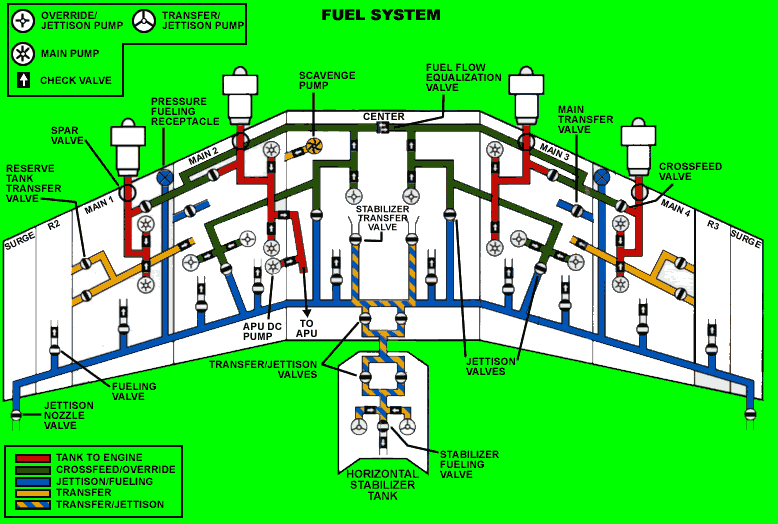
Detailed 747-400 fuel-tank layout. Tank names and capacities vary between the classic 747, 747-400 and 747-8 families.Select the map to open the full-size version.Boeing
Video
Frequently asked questions
- How much fuel does a Boeing 747 carry?
- It depends on the variant and installed options. Representative Boeing figures run from 48,445 US gallons for a 747-100 to 63,240 US gallons for a GE-powered 747-400ER with two body tanks. For the passenger 747-8, Boeing's January 2026 planning manual lists 63,034 US gallons in its general-characteristics table and 59,734 US gallons in its detailed tank table; the 747-8F figure is 59,734 gallons.
- Where is fuel stored on a Boeing 747?
- Most fuel is inside integral tanks between the front and rear spars of the wings. The common arrangement includes four main tanks, reserve tanks, a centre wing tank and surge tanks. Some 747-400 passenger aircraft also used a horizontal-stabilizer tank, while the 747-400ER could add body tanks in the forward cargo hold.
- Why does the 747 burn centre-tank fuel first?
- Centre-tank override pumps deliver at higher pressure than the main-tank boost pumps, so centre fuel takes priority when the system is configured for it. Keeping fuel in the outboard wing longer also helps reduce wing-root bending loads.
- Does each 747 engine have its own fuel tank?
- Each engine is normally associated with the same-numbered main tank, but the four feed lines are connected by a crossfeed manifold. With the valves configured, another tank can feed one or more engines.
- Can a Boeing 747 dump fuel?
- Yes. The jettison system can route fuel through nozzles near the wing tips to reduce aircraft weight after an early return or other situation. Crews use approved checklists and air traffic control coordination; jettison is not required for every overweight landing.
- What are the surge tanks on a 747?
- Surge tanks are vent-collector spaces near the wing tips. They receive fuel displaced by expansion, manoeuvring or overfill and allow the fuel tanks to breathe without routinely spilling fuel overboard.
- Did every Boeing 747-400 have a tail fuel tank?
- No. Horizontal-stabilizer fuel was configuration-dependent. Boeing planning data shows an optional 3,300-US-gallon tail-fuel increment on relevant 747-400 configurations, while the 747-400D and 747-400F did not use an active horizontal-stabilizer tank.
- How were the 747-400ER body tanks different from the centre wing tank?
- The centre wing tank is part of the aircraft's wing centre section. The 747-400ER's optional body tanks were separate auxiliary tanks in the forward lower cargo hold. Boeing lists two 3,060-US-gallon tanks in its current planning data.
- Does the Boeing 747-8 have a tail fuel tank?
- Boeing's January 2026 manual is internally inconsistent on the passenger 747-8. Its general-characteristics table lists 63,034 US gallons including tail-tank volume, while its detailed tank table lists no horizontal-stabilizer fuel and totals 59,734 gallons. The 747-8F is consistently listed at 59,734 gallons with no tail tank.
- What changed after the TWA Flight 800 accident?
- The investigation drove industry-wide work on ignition prevention, wiring and pump safety, fuel-tank maintenance limits and flammability reduction. Later systems use nitrogen-enriched air to reduce oxygen in vulnerable tank ullage spaces.
Sources
Facts on this page are checked against the primary and institutional references below.
- 747-100, -200, -300 and SP Airplane Characteristics for Airport Planning (D6-58326) - Boeing Commercial Airplanes
- 747-400 and 747-400ER Airplane Characteristics for Airport Planning, Revision F - Boeing Commercial Airplanes
- 747-8 Airplane Characteristics for Airport Planning, Revision E - Boeing Commercial Airplanes
- Boeing airplane characteristics plan manuals - Boeing Commercial Airplanes
- Boeing 747-100 fuel-tank safety lessons from TWA Flight 800 - Federal Aviation Administration
- TWA Flight 800 investigation - National Transportation Safety Board
- Airworthiness Directive 2007-13-04 - Boeing 747-400 centre fuel tanks - Federal Aviation Administration
- Fuel-tank flammability reduction special conditions for Boeing 747 aircraft - Federal Aviation Administration / Federal Register
- Fuel Tank Safety Project Report - 747-400 CWT and HST diagrams - NASA / Federal Aviation Administration
Related topics
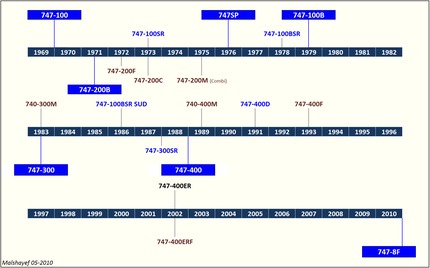
Boeing 747 Family
Every Boeing 747 variant built between 1968 and 2023 - the 747-100, -200, -300, -400 and 747-8, with freighter, combi and short-range models explained.
Boeing 747 Production Data
Download Boeing 747 production totals by generation, with a transparent method and links to Boeing's final programme record and technical documents.
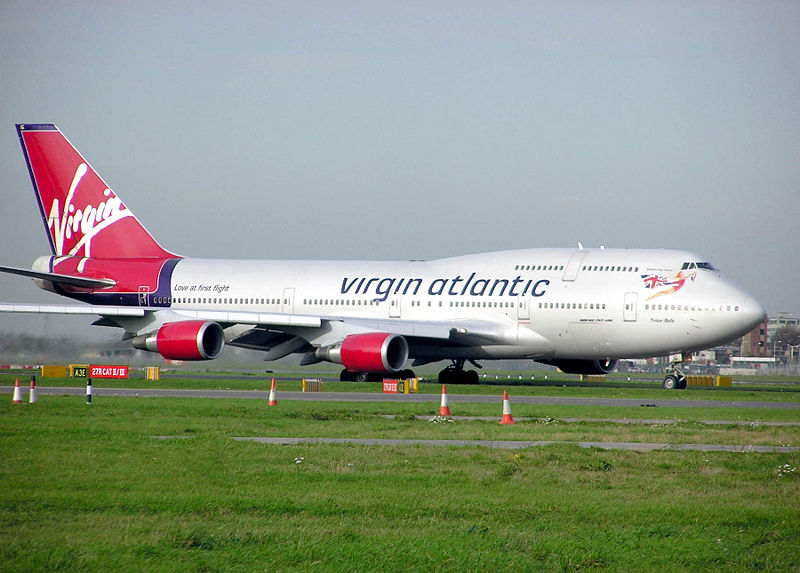
How to Identify Boeing 747 Variants
Identify Boeing 747 variants from photographs using upper-deck length, wingtip shape, fuselage length, engine nacelles and freighter doors.
Polar Air Cargo Boeing 747 fleet history
Polar Air Cargo has flown 44 Boeing 747s since 1994 and currently operates two 747-8 freighters for Atlas Air.
Compare aircraft sizes
Compare Boeing 747 variants, the Airbus A380 and Boeing 777 on one scale. Overlay their dimensions, switch views and see lengths and wingspans.
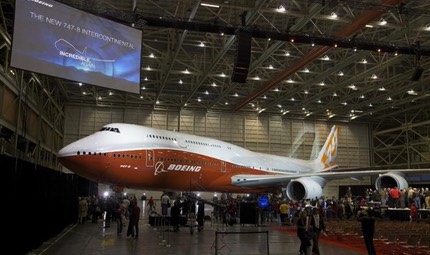
Boeing 747: History, Variants and Legacy
A complete reference to the Boeing 747, built from 1968 to 2023 - every variant from the 747-100 to the 747-8, plus special-mission jumbos and photos.
More in Aircraft Systems
How the 747 works
The systems that make a 747 fly - fuel, hydraulics, landing gear, electrics and pressurisation, explained one at a time.
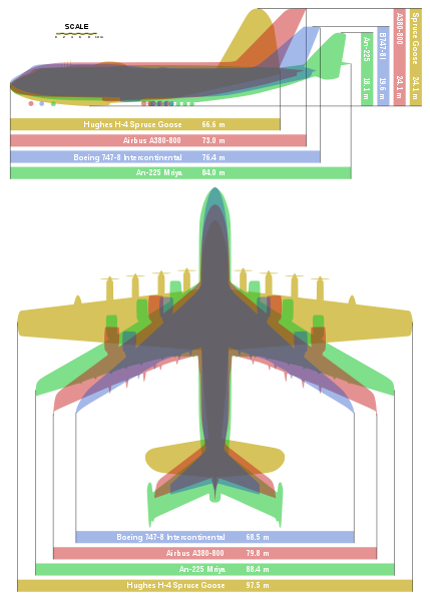
Boeing 747 specifications compared
Compare Boeing 747 dimensions, performance and detailed later-variant weights, fuel and cargo capacities, with Boeing planning configurations identified.
Boeing 747 Freighter Specifications
Compare Boeing 747-400F, 747-400ERF and 747-8F weights, structural payload, fuel and cargo volumes using identified Boeing planning configurations.
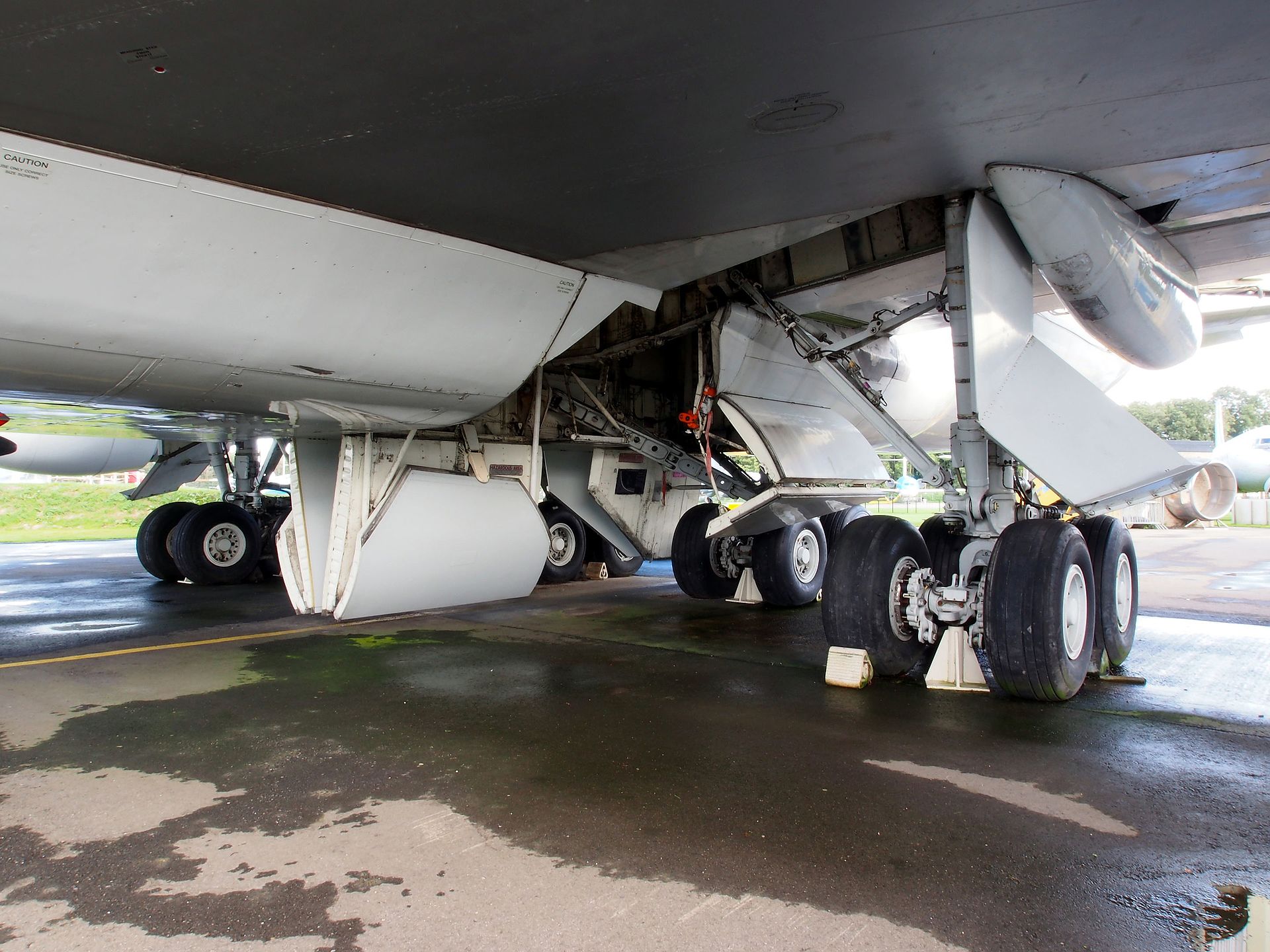
The four hydraulic systems
The 747 has four independent hydraulic systems, one per engine, each with a backup pump - and the reasoning behind splitting them that way.
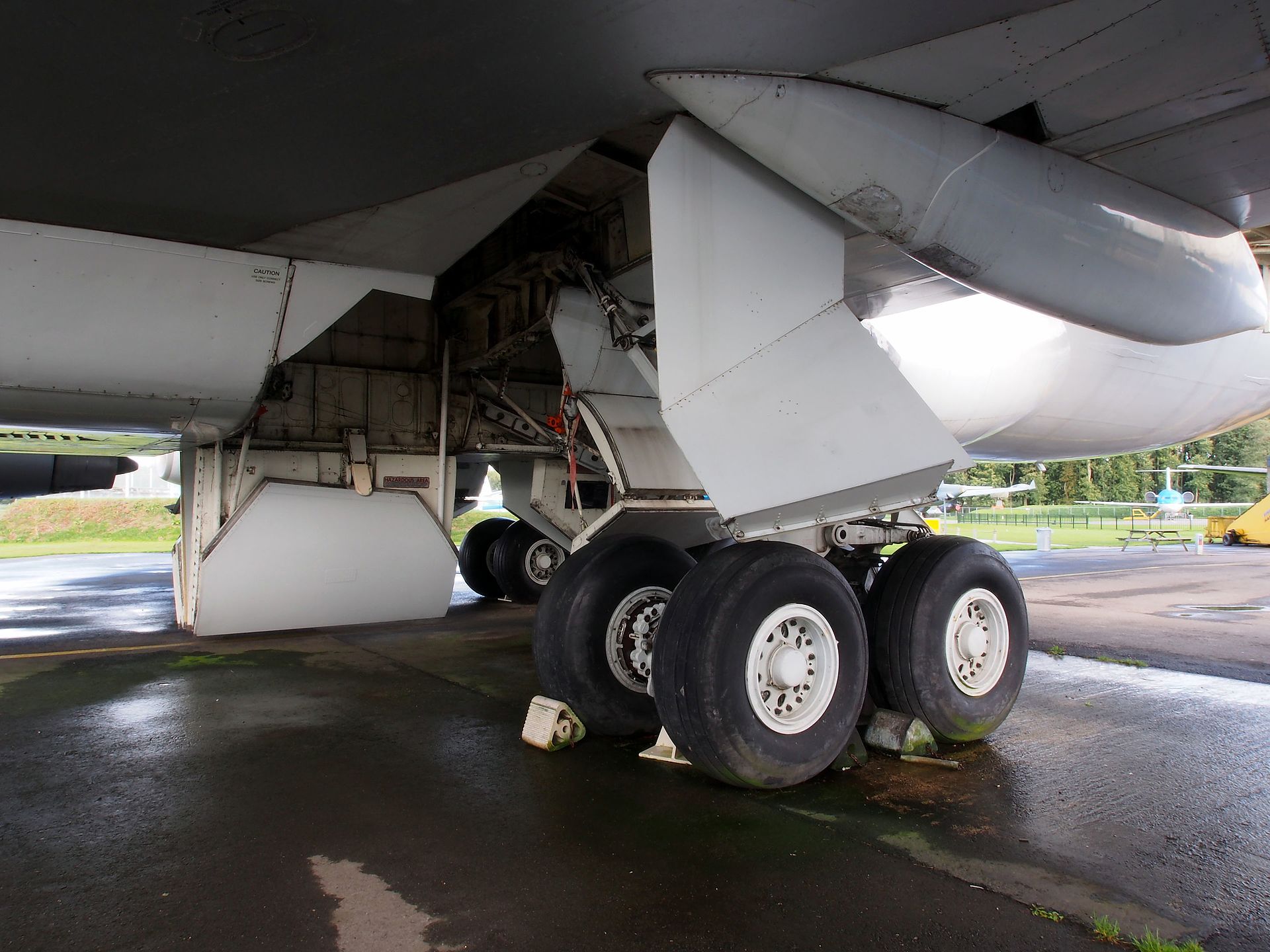
Eighteen wheels
The 747's five landing gear legs and 18 tyres, why the load is spread that way, and the body gear steering that stops it tearing up taxiways.
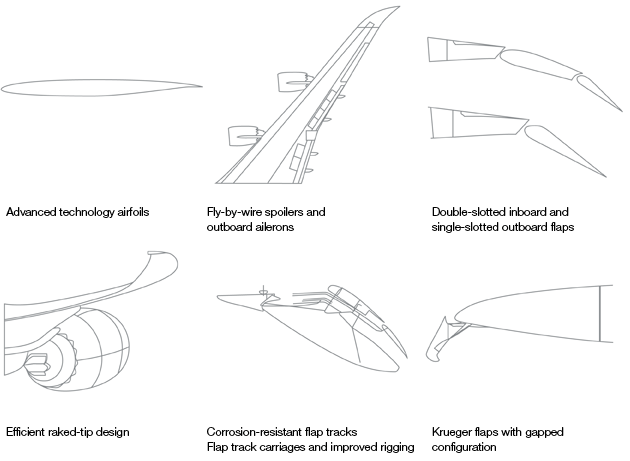
Flight controls and high-lift devices
How a 747 is flown - split ailerons, spoilers, triple-slotted flaps and Krueger leading edge devices, and what the 747-8 changed.