The story of the Boeing 747
The 747 was the first wide-body airliner, launched on a Pan Am order in 1966, built in a factory that had to be built first, and produced until 2023.

The Boeing 747 was the first wide-body airliner, and for 37 years the largest passenger aircraft in the world. 1,574 were built between 1968 and 2023.
This page is the short version. Every claim here is covered in more depth elsewhere on the site, and linked as it comes up.
The bet
By the mid-1960s air travel was growing faster than airports and airways could absorb. The answer, as Pan Am’s Juan Trippe saw it, was not more flights but bigger aeroplanes — and he wanted one roughly twice the size of the 707.
Boeing agreed to build it. Pan Am ordered 25 aircraft in April 1966, and that order launched the programme.
It was an enormous risk for both. Boeing was committing to an aircraft larger than anything in service, on a schedule of about four years, having just lost the competition for a very large military transport that had informed the design thinking. The company had no building big enough to assemble it in.
The factory came first
Boeing chose a site at Everett, Washington, and built the assembly plant and the aircraft more or less simultaneously — clearing forest, laying the largest building in the world by volume, and starting production before it was finished.
The engineering team, led by Joe Sutter, took the aircraft from launch to first flight in roughly 28 months. They became known inside the company as “the Incredibles”, and the name stuck.
The 747 first flew from Paine Field on 9 February 1969, and entered service with Pan Am on the New York–London route on 22 January 1970.
Why it looks like that
The hump is the most recognisable feature in commercial aviation, and it exists for a reason that had nothing to do with passengers.
Boeing expected supersonic transports to take over long-haul passenger flying within a decade or two. The 747 was therefore designed to have a second life as a freighter — which meant a nose that could hinge upward so cargo could be driven straight in along the centreline. Putting the flight deck above the main deck was the only way to leave that nose clear.
The supersonic airliners never arrived in numbers. The freighters very much did, and 747 freighters outlived the passenger versions by decades. The hump, designed for a future that did not happen, became the shape everyone recognises.
On the earliest aircraft the space behind the flight deck was a lounge rather than a cabin — with piano bars and swivel chairs — until fuel prices made every square foot earn its keep.
How it developed
Each generation is covered in detail in the 747 family section; the short version is:
| Generation | Built | The change that mattered |
|---|---|---|
| 747-100 | 168 | The original |
| 747-200 | 393 | Engine choice from all three makers — it outsold the -100 two to one |
| 747-300 | 81 | The stretched upper deck, kept by every 747 afterwards |
| 747-400 | 694 | Winglets, a glass cockpit, and no flight engineer |
| 747-8 | 155 | A longer fuselage and an entirely new wing |
Two variants broke the pattern. The 747SP had nearly 48 feet removed so it could fly further than anything else in the sky, and the 747-400D was built without winglets for Japanese domestic routes, where they would never repay their weight.
Away from the airlines, the type carried space shuttles, a telescope, fire retardant, other aeroplanes, a laser and several heads of state.
Records and reach
The 747 was the largest passenger aircraft in the world until the Airbus A380 entered service in 2007.
Its most extraordinary single flight was not a record attempt. In 1991, during Operation Solomon, an Israeli 747 carried more people on one aircraft than any flight before or since. Guinness World Records puts it at 1,088, including two babies born on board; contemporary reports ranged from 1,078 to 1,122. More on the records.
In 1989 a Qantas 747-400 flew London to Sydney nonstop, 9,720 nautical miles in 20 hours 9 minutes — though it should be said this was a delivery flight with no passengers or freight and specially produced fuel.
Why it ended
Nothing went wrong with the aircraft. What changed was the economics around it.
Twin-engined aircraft — the 777, then the 787 and A350 — grew capable enough to fly the same long-haul routes on two engines instead of four, without needing 400 seats filled to make money. Airlines moved to flying more often, point to point, on smaller aircraft. Four engines became a liability rather than a reassurance.
Passenger 747 production effectively stopped in 2005. The freighters carried the programme for another eighteen years, because nothing else offered a nose door.
COVID-19 finished the passenger fleets. Retirements planned for 2021 and beyond were pulled forward, and in 2020 British Airways, Qantas, KLM and Virgin Atlantic all retired the type within months of each other.
The last 747 was delivered to Atlas Air on 31 January 2023, 54 years after the first one flew.
What is still flying
Four airlines still fly passenger 747s — Lufthansa, Air China, Korean Air and Rossiya. The freighter fleets are far larger, led by Atlas Air, UPS and Cargolux, and the aircraft delivered in the 2010s and early 2020s have decades of work ahead of them.
Two 747-8s are also being converted into the next Air Force One. The 747 will be carrying heads of state long after the last airline retires one.
Read more
- The 747 family — every variant, with production numbers
- 747 development timeline — first order to last delivery, by date
- Special Boeing 747s — the aircraft that never flew for an airline
- Airlines — who flew it, and when each said goodbye
- Fun facts from Boeing — six million parts, and other numbers
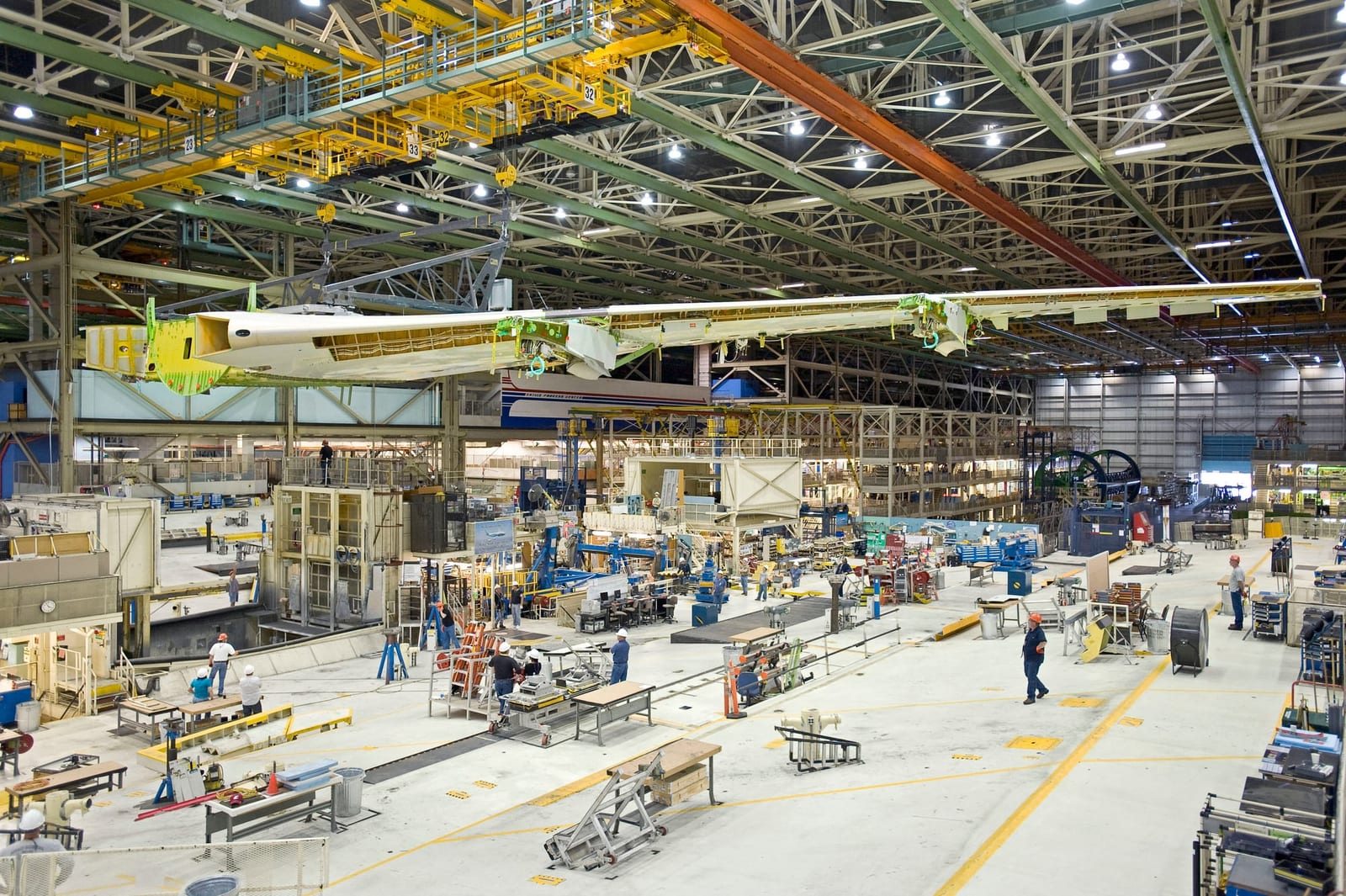
Everett, built for this aircraft and still the largest building in the world by volume.Boeing

Frequently asked questions
- Why does the Boeing 747 have a hump?
- Because Boeing expected supersonic airliners to take over passenger flying and designed the 747 to convert into a freighter. A freighter needed a nose that hinged upward for loading, which meant the flight deck had to sit above the main deck. The supersonic airliners never arrived; the freighters did.
- How many Boeing 747s were built?
- 1,574, between 1968 and 2023. The last, a 747-8 Freighter, was delivered to Atlas Air on 31 January 2023.
- Who designed the Boeing 747?
- Joe Sutter led the engineering team, whose members became known as "the Incredibles" for delivering the aircraft in roughly 28 months.