Boeing 747-8: Final Generation Overview
The 747-8 was the final and largest 747 generation. The last one built closed the production line in January 2023.

The Boeing 747-8 was the fourth and final generation of the 747: a longer fuselage, an entirely new wing, and four GEnx-2B engines. With a maximum takeoff weight of 987,000 lb (447,700 kg) it is the heaviest aircraft, commercial or military, ever manufactured in the United States.
Boeing announced the 747 Advanced as the "747-8" on 14 November 2005. The first 747-8 Freighter went to Cargolux in October 2011 and the first Intercontinental to Lufthansa in May 2012. 155 were built - 107 freighters and 48 passenger aircraft - and the very last 747, a Freighter for Atlas Air, was delivered on 31 January 2023, closing a production run of 1,574 aircraft.
Along with the 747SP, it is one of only two 747 variants whose fuselage length was ever changed from the original - and the only one that was ever lengthened.
The stretch
The 747-8 is 18 ft 3 in (5.6 m) longer than the 747-400, at 250 ft 2½ in (76.26 m) overall. The extra length comes from two fuselage plugs: 13 ft 4 in ahead of the wing and 5 ft behind it.
That made it the longest passenger airliner in the world on entry into service, exceeding the Airbus A340-600 by about 3.6 ft.
The wing
The wing was the largest engineering change, and it was a complete redesign rather than a modification.
Boeing kept the sweep and basic structure to contain cost, but made the wing thicker and deeper with the aerodynamics recalculated from scratch - a different pressure distribution and different bending moments. Boeing's January 2026 general-characteristics table gives the passenger version 63,034 US gal (238,609 L) including tail-tank volume; the same manual's detailed tank table gives 59,734 US gal and no horizontal-stabilizer quantity, so the exact planning configuration matters. (Programme material from 2005 - 08 quoted a planned 64,225 US gal.)
Other changes:
- Single-slotted outboard flaps and double-slotted inboard flaps.
- Raked wingtips replacing the -400's upright winglets - the same solution used on the 777-200LR, 777-300ER, 767-400ER and 787. They reduce the wingtip vortices at the lateral edges of the wing, cutting wake turbulence and drag.
- Some carbon fibre reinforced plastic in the airframe to save weight, though structural changes overall were evolutionary rather than revolutionary against the -400.
One neat consequence: because the redesigned wing carried so much more fuel, Boeing did not need to rework the horizontal tail to take auxiliary tanks - a saving that came free with the new wing. The vertical tail was raised slightly, to 64 ft 2 in (19.6 m).
There is a detailed page on the 747-8 wing in the reference section.
The engines
The General Electric GEnx - one of the two powerplants offered on the 787 - was the only engine ever available on the 747-8. The 747 version was adapted to provide bleed air for conventional aircraft systems, and given a smaller fan diameter to fit under the 747 wing.
An exclusivity agreement between GE and Boeing meant no other manufacturer's engine could be fitted for at least ten years. For an aircraft whose predecessor's success rested substantially on offering three engine choices, that was a striking reversal - and it removed one of the reasons airlines had historically chosen the 747.
A difficult programme
The 747-8 did not have an easy birth. Production of the first Freighter began at Everett in early August 2008. On 14 November 2008 Boeing announced a delay, citing limited availability of engineering resources inside the company, design changes, and a factory workers' strike. First Freighter delivery slipped from late 2009 to the third quarter of 2010; the Intercontinental slipped from late 2010 to the second quarter of 2011.
By February 2009 only one airline customer - Lufthansa - had ordered the passenger version, and Boeing publicly reassessed the project. Chief executive Jim McNerney said continuation was not a foregone conclusion.
The programme continued, but that early warning proved accurate: the passenger version never found a broad market, and the freighter carried the aircraft to the end.
Against the A380
The 747-8 was pitched directly against the Airbus A380 on long-haul routes, and both were shaped by the same bet - that hub-to-hub traffic would keep growing and airlines would want ever-larger aircraft.
The bet was wrong for both. Airlines moved to smaller, more efficient twins flying point-to-point, and neither very large aircraft sold as hoped. A380 production ended in 2021; the 747 followed in 2023.
The two versions
- The 747-8 Intercontinental - the passenger aircraft. 48 built.
- The 747-8 Freighter - the cargo aircraft, which flew first and sold better. 107 built.
For a fuller treatment of the aircraft, see Everything about the Boeing 747-8.
| Manufacturer | Boeing |
|---|---|
| Variant | 747-8 |
| Status | Out of production since January 2023 |
| Engines | General Electric GEnx-2B |
| Max takeoff weight | 987,000 lb (447,700 kg) |
| Number built | 155 (107 freighters, 48 passenger) |
Video
Sources
Facts on this page are checked against the primary and institutional references below.
Related topics
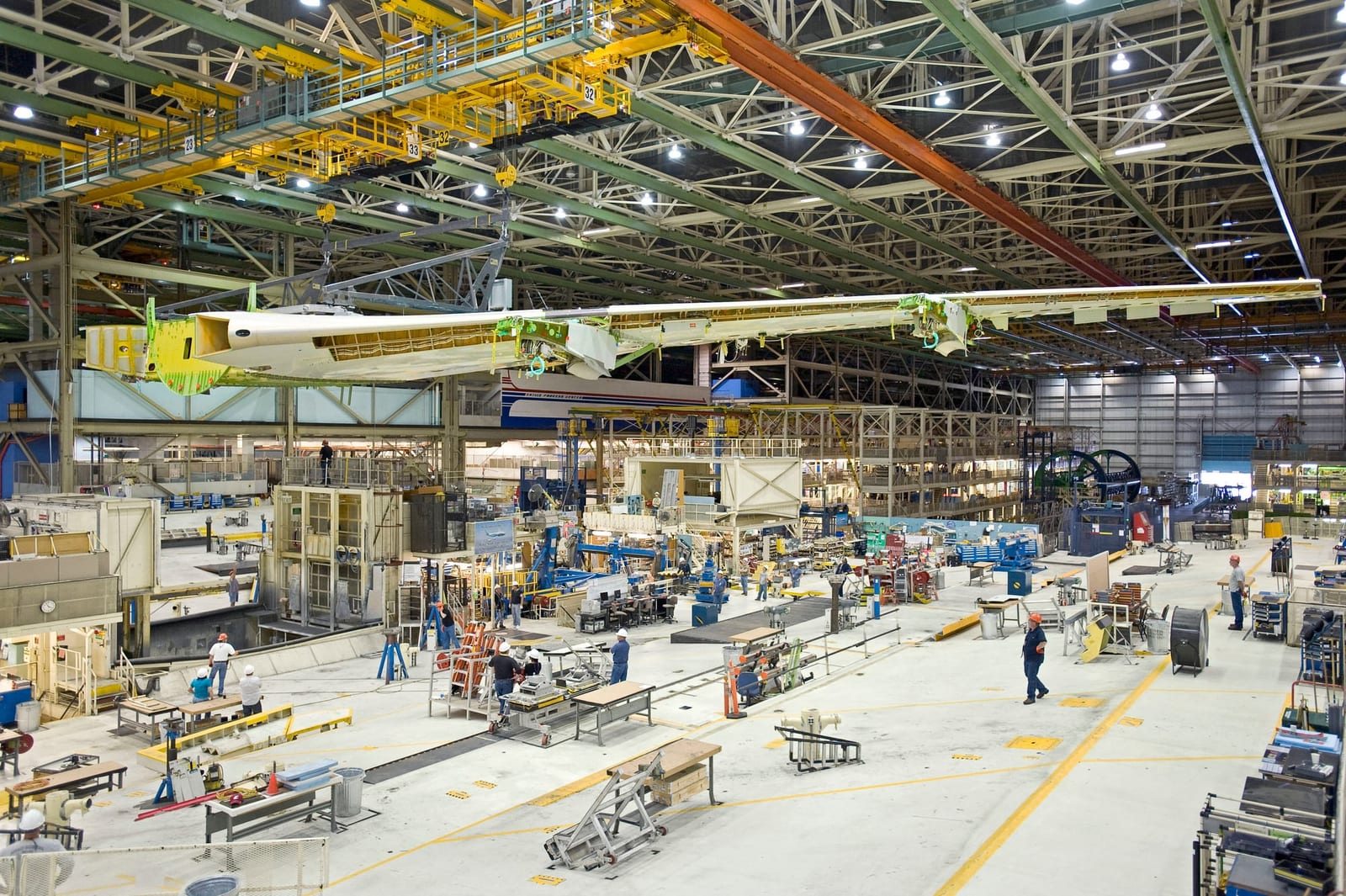
The Boeing 747-8 wing
The 747-8 replaced the 747-400 wing entirely - new airfoils, raked wingtips, fly-by-wire controls and a load-alleviation system that saved 1,400 lb.
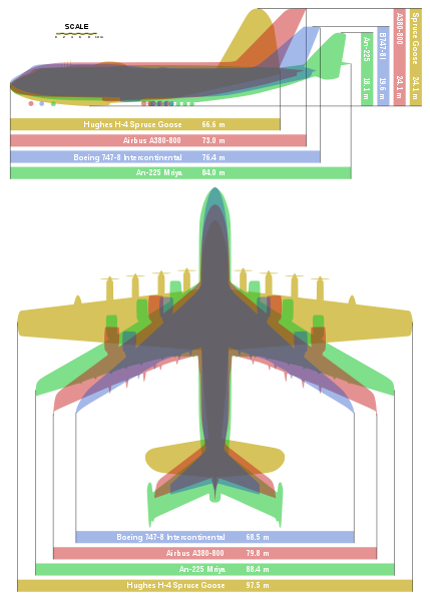
747 versus A380
The two largest airliners ever built, compared - size, capacity, economics, and why both are now out of production.
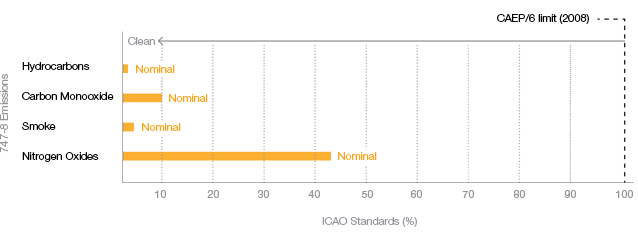
The 747-8 and the environment
The 747-8 meets emissions limits for hydrocarbons, carbon monoxide, smoke and nitrogen oxides, with a noise footprint about 30 percent smaller than the 747-400.
Compare aircraft sizes
Compare Boeing 747 variants, the Airbus A380 and Boeing 777 on one scale. Overlay their dimensions, switch views and see lengths and wingspans.
Listen to Boeing 747 engines
Listen to licensed Boeing 747 recordings, compare RB211 and GEnx-2B engines, filter by flight phase and download credited audio clips.
A stretched 747-400 with one new engine
The 747-8 is a re-engined, stretched 747-400 derivative with GEnx engines, a bigger APU and more electrical power.
More in Boeing 747 Family
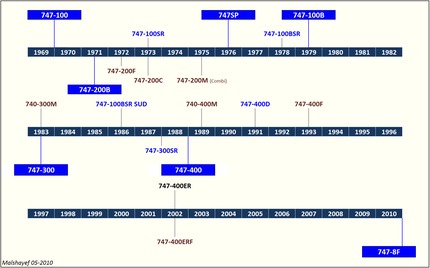
Boeing 747 Family
Every Boeing 747 variant built between 1968 and 2023 - the 747-100, -200, -300, -400 and 747-8, with freighter, combi and short-range models explained.
Boeing 747 Production Data
Download Boeing 747 production totals by generation, with a transparent method and links to Boeing's final programme record and technical documents.
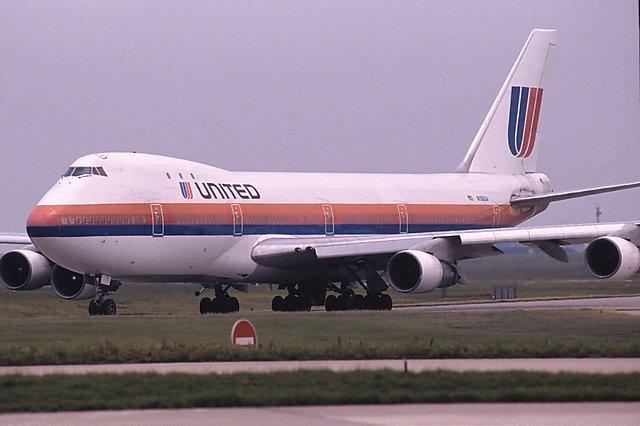
747-100
The original Boeing 747-100 entered service in 1970 with six upper-deck windows and a lounge; later aircraft offered a ten-window upper deck.
747-100B
The 747-100B added a stronger airframe and undercarriage and a 750,000 lb maximum takeoff weight. Only Iran Air and Saudia took delivery.
747-100F
Freighter specification for the Boeing 747-100F, covering main-deck and belly cargo volumes, pallet counts and upper-deck crew lounge options.
747-100SR
Built for Japanese domestic routes, the 747-100SR traded fuel capacity for seats, carrying up to 550 passengers on short high-frequency sectors.