Boeing 747-400ER
The Boeing 747-400ER was a higher-weight, longer-range 747-400 built only six times as a passenger aircraft, all for Qantas. All six carried a single body fuel tank; the certificated two-tank option was never taken up, and no example survives.
| Manufacturer | Boeing Commercial Airplanes |
|---|---|
| Variant | 747-400ER (747-438ER in Qantas service) |
| First flight | 31 July 2002 |
| Introduced | 8 November 2002 with Qantas |
| Status | All six scrapped; no example preserved |
| Engines | Four GE CF6-80C2B5F turbofans on Qantas aircraft |
| Typical capacity | 416 passengers in the source planning layout; airline layouts vary |
| Range | Up to 7,580 nmi (14,205 km), mission-dependent |
| Length | 231 ft 10 in (70.66 m) |
| Wingspan | 211 ft 5 in (64.44 m) |
| Tail height | 63 ft 8 in (19.4 m) |
| Max takeoff weight | 910,000 lb (412,769 kg) |
| Max landing weight | 652,000 lb (295,742 kg) |
| Max zero-fuel weight | 555,000 lb (251,744 kg) |
| Representative operating empty weight | 406,900 lb (184,567 kg) |
| Representative structural payload | 148,100 lb (67,177 kg) |
| Usable fuel capacity | 63,240 US gal (239,389 L) - two-tank planning option; see Qantas configuration below |
| Lower-deck cargo volume | 4,550 cu ft (128.8 m³) container space + 789 cu ft (22.3 m³) bulk |
| Cruise speed | Mach 0.85 typical planning cruise |
| Number built | 6 passenger aircraft |
| Configuration and assumptions | GE-powered airport-planning example with two body fuel tanks. This is the planning option, not the single-tank configuration delivered to Qantas. OEW assumes 416 seats in three classes. |
| Technical reference | Boeing D6-58326-1, Revision F (December 2024), printed page 2-11. |
The Boeing 747-400ER was the final passenger development of the 747-400. It kept the standard aircraft's dimensions and unmistakable shape, but used a strengthened airframe, a higher maximum takeoff weight and an optional extra fuel tank to make demanding long-haul routes more practical. Its maximum takeoff weight of 910,000 lb gave it the industry nickname "910k".
Only six passenger 747-400ERs were built, all for Qantas. That makes it one of the rarest production 747 variants and a particularly important chapter in the history of long-range flights across the Pacific.
The short version: compared with the standard 747-400, the -400ER could fly about 435 nautical miles (805 km) farther or carry 15,000 lb (6,800 kg) more payload. The operator chose how to use the extra takeoff weight on each mission. All six aircraft carried a single auxiliary body fuel tank - the two-tank option was certificated, provisioned for at the factory, and never taken up by anyone.
On this page
- Specifications
- From 747-400X to 747-400ER
- What changed from the 747-400
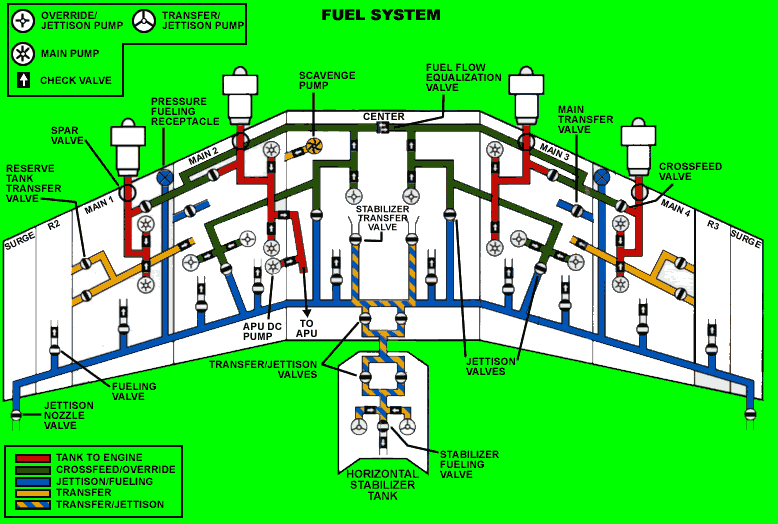
- Fuel capacity and the body tanks
- The two-tank option nobody took
- Range and payload
- Why Qantas needed the 747-400ER
- Sydney to Dallas/Fort Worth
- The six Qantas aircraft
- Retirement and the final flight
- The last missions
- 747-400ER versus 747-400ERF
- Frequently asked questions
Boeing 747-400ER specifications
The figures below use Boeing's current airport-planning data where available. Range and operating-empty-weight figures should always be treated as planning values: an airline's seating, cargo, reserves, weather and operating procedures change the result of any real flight.
| Specification | Boeing 747-400ER passenger aircraft |
|---|---|
| Flight crew | 2 pilots |
| Typical passenger capacity | 416 in Boeing's three-class planning layout |
| Typical two-class capacity | 500 in Boeing's current planning layout |
| Length | 231 ft 10 in (70.66 m) |
| Wingspan | 211 ft 5 in (64.44 m) |
| Tail height | 63 ft 8 in (19.4 m) |
| Maximum design taxi weight | 913,000 lb (414,129 kg) |
| Maximum design takeoff weight | 910,000 lb (412,769 kg) |
| Maximum design landing weight | 652,000 lb (295,742 kg) |
| Maximum design zero-fuel weight | 555,000 lb (251,743 kg) |
| Maximum structural payload | 148,100 lb (67,177 kg) |
| Typical planning cruise | Mach 0.85 |
| Published maximum range | Up to 7,580 nmi (14,205 km), mission-dependent |
| Qantas engines | 4 × General Electric CF6-80C2B5F turbofans |
| Usable fuel as actually built | 60,495 US gal (228,990 L) - one body tank, all six aircraft |
| Usable fuel, two-tank option | 63,240 US gal (239,389 L) - certificated, provision built in, never taken up |
| Maximum belly cargo volume | 5,599 cu ft (158.6 m³), reduced from 6,025 cu ft on the -400 |
| Passenger aircraft built | 6 |
The headline range is not a promise that every 747-400ER could carry every payload for 7,580 nautical miles. Aircraft range is a curve, not a single number. Boeing's own charts plot range against operating weight, payload, takeoff weight and engine type at a stated cruise condition.
From 747-400X to 747-400ER
Boeing formally launched the aircraft on 28 November 2000, after Qantas ordered six. During development it had been known as the 747-400X and then the Longer-Range 747-400. The final commercial name, 747-400ER, made its purpose clearer: this was an extended-range member of the existing -400 family, not a new-size 747.
The first aircraft rolled out at Everett on 17 June 2002 and flew for the first time on 31 July 2002. Boeing used two aircraft in a certification programme planned around roughly 230 flight-test hours and 380 ground-test hours.
Qantas accepted the first delivered aircraft on 30 October 2002. It entered commercial service on 8 November 2002 as QF11 from Sydney to Los Angeles. Deliveries of all six were complete by July 2003.
What changed from the standard 747-400
The -400ER was not stretched, and its wing planform did not change. Its main differences were beneath the skin and inside the aircraft.
Because 910,000 lb was such a distinctive number, the type picked up an industry nickname: the "910k", after its maximum takeoff weight in thousands of pounds. It is a small thing, but it is how the variant was usually referred to in production and airline circles.
Higher weights and stronger structure
Maximum design takeoff weight rose from the 747-400 baseline of 875,000 lb (396,893 kg) to 910,000 lb (412,769 kg). To carry that extra weight, Boeing strengthened parts of the fuselage, wing and landing gear. The aircraft also received larger radial tyres.
That 35,000 lb increase did not automatically mean the aircraft carried 35,000 lb more payload. Boeing raised takeoff weight while the maximum zero-fuel weight remained a separate structural limit. On a long mission, much of the extra allowance was used for fuel; on a shorter mission, some could support additional traffic load.
Engine options
Boeing offered three engine choices for the -400ER, each rated higher than the standard 747-400 equivalent:
| Manufacturer | Model | Rated takeoff thrust |
|---|---|---|
| General Electric | CF6-80C2B5F | 62,100 lb |
| Pratt & Whitney | PW4062 | 63,300 lb |
| Rolls-Royce | RB211-524H8-T | 59,500 lb |
For comparison, the standard 747-400's published options were the CF6-80C2B1F at 57,900 lb, the PW4056 at 56,750 lb and the RB211-524G2 at 58,000 lb - so the -400ER offered roughly 3,000 - 4,500 lb more thrust per engine depending on the choice.
Qantas took all six aircraft with General Electric CF6-80C2B5F engines, which is why GE is the only powerplant you will see in photographs of the type. The GE CF6 programme page covers the engine family in detail.
Updated flight deck and cabin
Boeing fitted new liquid-crystal flight-deck displays and worked to reduce flight-deck noise. The passenger cabin used the Boeing Signature Interior, an evolution of the interior architecture introduced on the 777, with redesigned bins, ceiling panels and lighting. The bins used a pivot design that gave roughly 30% more roll-aboard bag space than the standard 747-400, and the upper deck gained twice the stowage capacity.
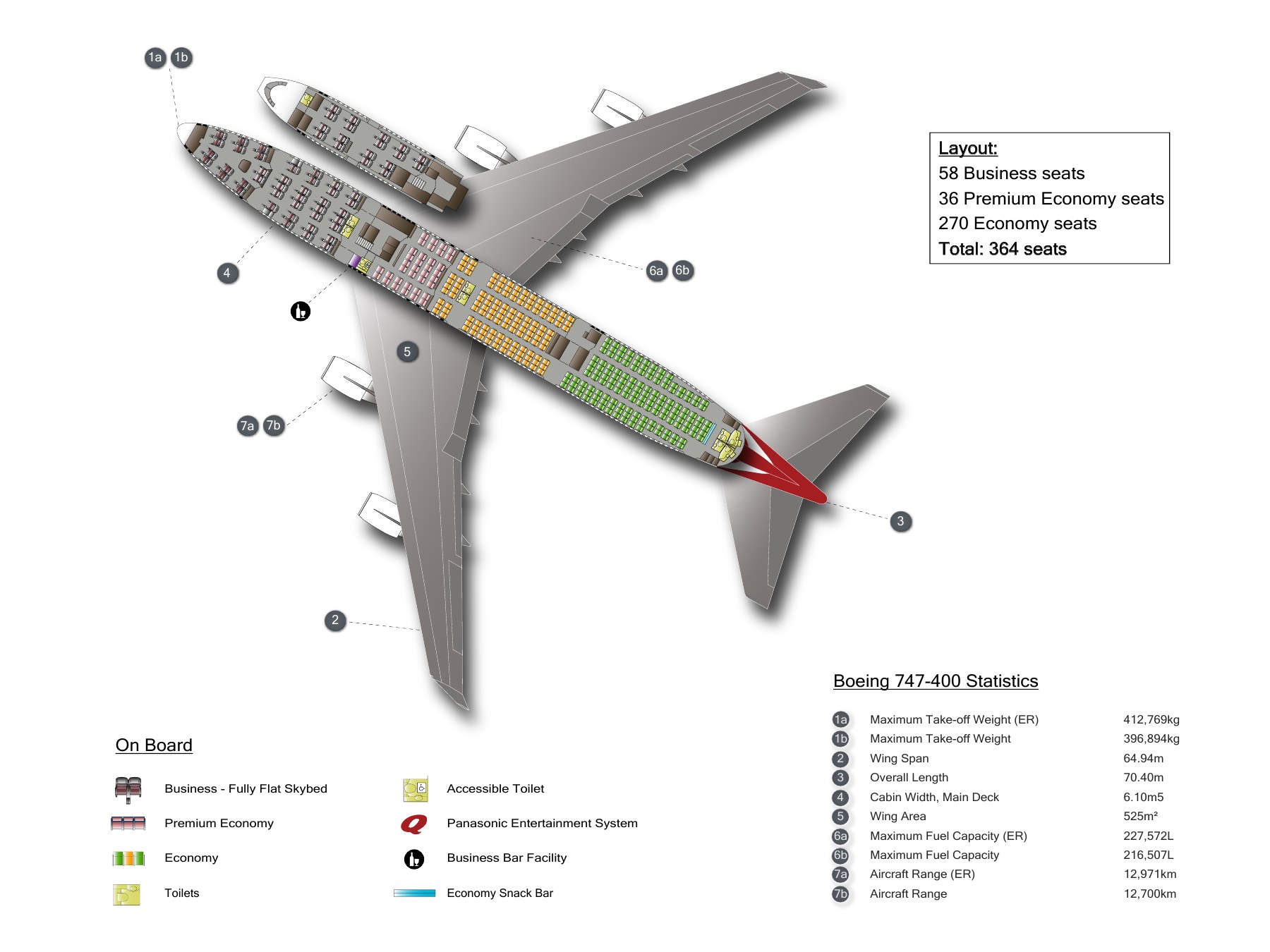
Qantas fitted A380-style seating and in-flight entertainment to its 747-400s during the 2010s, starting with nine airframes completed at Melbourne (Avalon) from late 2011. The -400ERs were part of that programme, which is why later photographs of the type show a 58 business / 40 premium economy / 270 economy layout rather than the four-class arrangement the aircraft originally carried. The Qantas seat maps page documents that late-career layout.
A choice between range and payload
The commercial proposition was deliberately simple: use the added takeoff weight to fly approximately 435 nmi (805 km) farther, or carry approximately 15,000 lb (6,800 kg) more payload. A real flight could use a combination of the two.
| Feature | Standard 747-400 | 747-400ER |
|---|---|---|
| External dimensions | 231 ft 10 in long; 211 ft 5 in span | Identical |
| Comparison MTOW | 875,000 lb | 910,000 lb |
| Usable fuel with GE engines | 57,065 US gal | 60,495 US gal as built |
| Body fuel tanks | None | One as built; two certificated, never taken up |
| Maximum belly cargo | 6,025 cu ft | 5,599 cu ft |
| Advertised capability gain | Baseline | +435 nmi range or +15,000 lb payload |
| Typical Boeing three-class layout | 416 seats | 416 seats |
| Passenger production | Main -400 variant | 6 aircraft, all for Qantas |
Fuel capacity and the body tanks
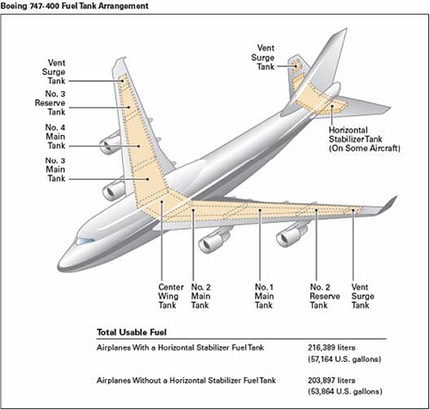
The defining equipment was a set of optional auxiliary body fuel tanks installed in the forward lower cargo compartment. One tank could be fitted, or two for maximum fuel capacity. The current Boeing airport-planning manual lists each tank at 3,060 US gallons (11,582 L).
Every 747-400ER that ever flew had only one
This is the most commonly repeated error about the type, and it is worth stating plainly: although Boeing certified the -400ER for two body tanks, Qantas ordered only the single-tank version, and no 747-400ER was ever delivered with two. The two-tank figure of 63,240 US gallons appears constantly online, including in the aircraft's own published specification, but it describes an airframe that never existed.
| Configuration | Usable fuel | Status |
|---|---|---|
| Standard 747-400, GE engines | 57,065 US gal | Baseline |
| 747-400ER with one body tank | 60,495 US gal (228,990 L) | All six Qantas aircraft |
| 747-400ER with two body tanks | 63,240 US gal (239,389 L) | Certificated option, never built |
So the honest answer to "how much fuel could a 747-400ER carry?" is 60,495 US gallons. Treat the 63,240-gallon figure as a design envelope rather than a fact about any individual aircraft.
The two-tank option nobody took
The second tank is the most interesting thing about the -400ER that never happened, and it is worth treating as a real design decision rather than a footnote.
It was a designed-in option, not an afterthought. Boeing's programme documentation is explicit that the aircraft was built with the second position in mind: structural and systems provisions for a second fuel cell were provided at the factory, and the cell could be ordered as an option or installed later. Crucially, the one-cell and two-cell installations present to the crew as a single auxiliary tank - the fuel management system did not change, and the handling characteristics did not change. There was also a switch added to the fuel management area of the pilot's overhead panel so the crew could drive the transfer valves manually, though Boeing noted that because the tank integrated seamlessly with the existing system, the flight crew's workload did not increase.
In other words, a -400ER could have been converted to two tanks. The option was real, certificated and supported by the spares and tooling. Nobody used it.
Why the arithmetic was already spoken for. The obvious objection is that Qantas might simply have wanted more range. The published weights suggest it could not have had both. Doing the arithmetic on Boeing's own figures:
| Quantity | Weight |
|---|---|
| Body tank fuel, one tank (3,060 US gal at ~6.7 lb/gal) | ~20,500 lb |
| Body tank fuel, two tanks | ~41,000 lb |
| Maximum takeoff weight increase over the 747-400 | 35,000 lb |
Two full body tanks hold roughly 6,000 lb more fuel than the entire maximum takeoff weight increase the variant was granted - and that is before counting the dry weight of the second tank's own structure. On a two-tank aircraft, the extra 20,500 lb of fuel is not free range bought with the higher MTOW limit; it is weight that has to come out of payload, or out of the fuel load itself.
That matters because Boeing's headline claim for the -400ER was a straight trade: +435 nmi of range or +15,000 lb of payload. Those are alternatives, not simultaneous benefits. The single-tank configuration is the one that makes the payload half of that claim meaningful, because one tank's ~20,500 lb of fuel sits comfortably inside the 35,000 lb allowance with room left over for traffic load. Add a second tank and the same 910,000 lb limit has to absorb 41,000 lb of fuel instead - which is the clearest technical reason the option existed on the drawing board and stayed empty in practice.
(This is arithmetic on published capacities, not a Boeing statement. It assumes both tanks filled to the certificated maximum, uses a nominal Jet A-1 density, and ignores tank dry weight - all of which make the real figure worse, not better. MTOW is a ceiling rather than a target, so an operator could always carry less fuel. But the direction of the trade is not in doubt.)
And the second tank was not free in the hold either. It occupied the same prime real estate - the forward lower cargo compartment, where LD-1 containers normally sit. Two tanks would have cost more belly capacity on top of the weight penalty, and belly freight is precisely the revenue Qantas was trying to protect on trans-Pacific runs.
So the two-tank 747-400ER is a genuine "what if". Boeing built the provisions, wrote the certification, and offered the conversion. A single customer looked at it and declined. Of the two configurations on the certificate, the one that was harder to sell on paper turned out to be the one that worked.
The tank itself
Marshall Aerospace designed and manufactured the lightweight tank system. Marshall's modern account describes its use of bonded, dual-wall aluminium honeycomb construction for auxiliary tanks: the aim is high strength with a competitive ratio of tank weight to fuel volume. That matters because every kilogram of tank structure displaces payload before any fuel is added. Marshall states that its tank designs carry roughly 15% more fuel volume than a conventional bladder tank in the same space, and that it ships them in sets of six - which is precisely the size of the Qantas order.
The tanks had a double wall, an integrated venting system, and their own control logic. Fuel in the body bought range, but the tanks occupied space in the forward lower hold. Airlines therefore gained mission flexibility rather than free capacity: the most useful arrangement depended on route length, cargo demand and required reserves.
How the fuel was actually managed
The auxiliary tank was not simply plumbed into the wing. Boeing's programme documentation describes a deliberate burn sequence:
- Fuel is used first from the centre wing tank, not from the body tank.
- As the flight progresses, fuel is transferred from the auxiliary tank into the centre tank in flight.
- That transfer is driven by cabin air pressure as the primary source, with an electrically powered pump providing the secondary source at low altitude, on the ground, and during fuel jettison.
- A modified Fuel System Management Card sequenced the transfer and coordinated it with the horizontal stabiliser tank.
- A switch in the fuel management area of the pilot's overhead panel lets the crew drive the auxiliary tank transfer valves manually.
The practical reason is structural. The centre wing tank sits between the wing root boxes, where load-relief valves manage fuel weight exactly as the wing flexes in flight. Keeping the burn and the transfer logic centred on that tank meant the body tank acted as a reserve that was emptied into the structurally protected centre section early in the flight, rather than as a working fuel source that had to be managed throughout cruise.
What the tank cost the airframe
Fitting a large pressure vessel inside the cargo hold required the surrounding structure to be redesigned, not merely strengthened. According to Boeing's own account of the programme:
- The body structure in the tank zone was completely redesigned, with existing sheet frames replaced by single-piece machined frames.
- Higher-strength material was used in the chords of the main-deck floor beams so they could survive a rapid decompression.
- A titanium shield was fitted on the forward body and wing ribs to reduce the chance of tank damage from a burst engine rotor.
- The tank was suspended on a six-point system with titanium fittings, isolated from normal airframe deflection, hanging 5 in (127 mm) above the cargo floor and 4 in (102 mm) below the cargo ceiling.
- A structural cargo barrier and liners separated the tank from the cargo compartment, and its immediate surroundings were designed to keep fuel within temperature limits in the rare event of a cargo fire.
- The cells could be rolled in and out on the cargo system rollers using a purpose-built tool, and were accessible for line-replaceable-unit servicing without removing them from the aircraft.
Two service relocations followed directly from the tank. The potable water system moved to the aft end of the aft cargo compartment, becoming a two-pump design instead of the pressurised single-pump arrangement on the standard 747-400, and components of the passenger oxygen system were relocated because the tank blocked access to their normal positions. The cabin also gained an electrically activated passenger oxygen system and an in-flight entertainment interface backbone, both developed first for the 777.
The forward hold shrank as a direct result. Maximum belly cargo volume fell from 6,025 cu ft on the standard 747-400 to 5,599 cu ft with 28 LD-1 containers and bulk freight, or 5,332 cu ft with five pallets, 14 LD-1 containers and bulk freight.
Why published fuel figures differ
Readers will find several 747-400ER fuel capacities online. Early Boeing material quoted as much as 63,705 - 63,765 US gallons, while Boeing's December 2024 airport-planning manual lists 63,240 US gallons for GE-powered aircraft and 63,460 US gallons for Pratt & Whitney or Rolls-Royce installations with two tanks. Per-tank capacity is itself quoted variously as 3,060, 3,210 and 3,240 US gallons depending on whether the source is a planning manual, a programme review or a secondary reference.
Those numbers come from documents prepared at different times and on different configuration bases. This page uses the current Boeing planning-manual figures for its main specification table, and flags the two-tank figures as unrealised. For flight planning or maintenance, the approved manuals for the individual aircraft always take precedence.
Range and payload explained
The -400ER's often-quoted maximum range is 7,580 nautical miles (14,205 km). It is best understood as a maximum planning figure under defined assumptions, not as a route radius available with any passenger and cargo load.
Several variables move the result:
- Payload: passengers, bags and cargo consume weight that might otherwise be fuel.
- Cabin configuration: seats, galleys, crew-rest modules and entertainment systems change operating empty weight.
- Wind and temperature: westbound Pacific sectors can face strong headwinds, while hot-weather departures may be performance-limited.
- Engine installation: Boeing published separate payload-range charts for GE, Pratt & Whitney and Rolls-Royce powerplants.
- Operational reserves: diversion fuel, holding fuel and airline policy all reduce usable trip range.
This is why Boeing's launch claim - 805 km farther or 6,800 kg more payload - is more informative than a single maximum-range number. It describes the extra capability relative to the standard aircraft without pretending every flight has the same loading problem.
The range figures do not agree
Expect to see several different maximum ranges published for the -400ER, and none of them is wrong in the way a typo is wrong:
| Published maximum range | Source basis |
|---|---|
| 7,260 nmi | Standard 747-400, for comparison |
| 7,580 nmi (14,205 km) | Boeing planning figure, widely quoted |
| 7,670 nmi | Boeing 747-400 series specification data |
| 7,760 nmi | A further Boeing figure quoted to press at the QF7 launch |
The same variation affects the claimed increment over the standard aircraft. Depending on the document, the -400ER is described as gaining 410 nmi, 435 nmi or 525 nmi over the -400. The differences come from cruise Mach number, reserve assumptions, step-climb rules and whether the figure is a ferry-range or a payload-range intercept - not from any disagreement about the aircraft.
Real Qantas operations sat well below all of these. On the Sydney - Dallas service the sector was about 7,454 nmi with a normal passenger and belly-cargo load, leaving little margin, which is exactly why the return flight so often had to stop at Brisbane. Range figures for the 747 should always be read as the far end of a curve, not as a radius.
Why Qantas needed the 747-400ER
Qantas's network combined very long sectors, large passenger demand and valuable belly freight. Boeing specifically cited Melbourne - Los Angeles as the kind of demanding route for which the extra capability mattered. Qantas said the new fleet would be used primarily on routes to the United States, and the first revenue flight was Sydney - Los Angeles.
The westbound leg to Australia could be especially demanding because of prevailing winds. The extra takeoff weight gave Qantas more options to carry commercially useful payload without an intermediate fuel stop or severe cargo restriction.
An Australian Transport Safety Bureau report also records VH-OEH operating San Francisco - Sydney in 2016, illustrating how the type continued to serve long trans-Pacific sectors late in its career.
Sydney to Dallas/Fort Worth: the -400ER's finest hour
If the -400ER justifies its own existence, it is here. On 16 May 2011 Qantas put a 747-400ER into service on Flight 7, the nonstop Sydney - Dallas/Fort Worth leg - 13,804 km (8,577 mi, 7,454 nmi) with a scheduled block time of 15 hours 25 minutes.
At launch it was:
- the longest regularly scheduled nonstop flight ever flown by a Boeing 747;
- the third-longest regularly scheduled nonstop commercial flight in the world, behind only Singapore Airlines' Newark - Singapore and Los Angeles - Singapore services - both of which were flown by A340-500s in all-business-class cabins carrying around 100 passengers, not 300.
That last comparison is the point. The Singapore flights were longer on the map but carried a fraction of the people. QF7 was long and full, which is exactly the combination the -400ER existed to make possible.
The route used a four-class layout of 14 First, 66 Business, 40 Premium Economy and 187 Economy seats - 307 in total, a noticeably premium-heavy configuration chosen for a sector where the front of the aircraft carries disproportionate value.
The westbound direction was the hard one, as always on the kangaroo route. Flight 7 flew nonstop; the return Flight 8 often could not, and diverted via Brisbane, where passengers were offloaded to enable the extra 441 km to Sydney. Strong headwinds over the Pacific meant the return leg could not be flown within the -400ER's fuel capability on many days. The -400ER flew the route until 28 September 2014, after which Qantas moved it to the Airbus A380.
Qantas's decision to switch from San Francisco to Dallas as its Texas gateway was, in other words, a bet that the -400ER could close the gap. It could - but only just, and only eastbound.
The six Qantas 747-400ERs
Qantas was the only airline to order the passenger version. Its aircraft carried the Boeing designation 747-438ER - customer code 38 is Qantas, appended to the 747-400 model code, which is the same convention behind the 747-438 designation used for Qantas's standard 747-400s. The registration and customer-code decoder explains how Boeing's codes work.
Qantas named each aircraft after an Australian town. Early on, the names were not displayed on the outside of the aircraft, so a single photograph rarely identifies one.
| Registration | Name | MSN / line number | Accepted by Qantas | Notable point |
|---|---|---|---|---|
| VH-OEE | Nullabur | 32909 / 1308 | 6 December 2002 | First -400ER built; initially used in Boeing's flight-test programme |
| VH-OEF | Sydney | 32910 / 1313 | 31 October 2002 | First delivered to Qantas and first to enter commercial service |
| VH-OEG | Parkes | 32911 / 1320 | 20 December 2002 | Third airframe accepted; the 54th Boeing 747 delivered to Qantas |
| VH-OEH | Hervey Bay | 32912 / 1321 | 9 February 2003 | Documented by the ATSB on San Francisco - Sydney service in 2016 |
| VH-OEI | Ceduna | 32913 / 1330 | 26 June 2003 | Fifth of the six Qantas aircraft |
| VH-OEJ | Wunala | 32914 / 1331 | 30 July 2003 | Final Qantas 747; wore the Wunala Dreaming livery |
VH-OEE was the first airframe built, but VH-OEF reached Qantas first while the prototype completed test work. That is why "first built" and "first delivered" refer to different aircraft.
Qantas changed cabin layouts and liveries during the fleet's long service - the fleet carried the standard "New Roo" scheme as well as One World, Go Wallabies and Wunala Dreaming specials - so a seat map or photograph from one year should not be treated as representative of the type's entire career.
Retirement and the final flight
The economics of long-haul aviation moved toward large twin-engine aircraft. They could serve many of the same city pairs with fewer seats and two engines, while the niche for a higher-weight passenger 747 remained small. The -400ER therefore stayed a six-aircraft Qantas subfleet.
Qantas announced in May 2018 that it would retire its entire 747 fleet by 2020. In the event COVID-19 removed the remaining schedule almost overnight, and the airline brought the whole operation forward by six months.
The six aircraft left service over about four months:
| Registration | Final Qantas service | Left Australia | Fate |
|---|---|---|---|
| VH-OEF | 9 Feb 2020, QF99 Sydney - Los Angeles | Feb 2020 | Stored, San Bernardino Intl, California |
| VH-OEG | 23 Mar 2020, QF64 Johannesburg - Sydney | 10 Apr 2020 | Mojave Air and Space Port, scrapped |
| VH-OEI | 26 Mar 2020, QF64 Johannesburg - Sydney | 4 Jun 2020 | Mojave Air and Space Port, scrapped |
| VH-OEH | 26 Mar 2020, QF26 Tokyo Haneda - Sydney | 20 May 2020 | Mojave Air and Space Port, scrapped |
| VH-OEE | 29 Mar 2020, QF28 Santiago - Sydney | 17 Jun 2020 | Mojave Air and Space Port, scrapped |
| VH-OEJ | 22 Jul 2020, QF7474 Sydney - Los Angeles | 24 Jul 2020 | Mojave Air and Space Port, scrapped |
VH-OEF left first, in February, flying a normal scheduled service rather than a ceremonial one. It is the only one of the six still reported as intact and in storage; the other five went to the Mojave Desert, the graveyard where most of the world's retired 747s now sit. Qantas sold the fleet to GE Aviation Materials, which cancelled the aircraft from the Australian register in June 2020, and all six were ultimately parted out. Sections of VH-OEG's fuselage were later used by an aviation-themed accessories company.
No passenger 747-400ER survives anywhere. There is no preserved example, no museum airframe and no airworthy one. The type exists only in photographs, records and this page.
On its final flight VH-OEJ flew low over Sydney Harbour, dipped its wings to VH-OJA - Qantas's first 747-400, preserved at the HARS Aviation Museum - and departed to I Still Call Australia Home. The farewell flights page covers the ceremony in detail.
The last missions: evacuation and charter work
Before it was scrapped, VH-OEE flew two of Australia's early COVID-19 evacuation flights in February 2020: the first evacuation from Wuhan, and the Diamond Princess repatriation.
On 2 - 3 February 2020 it operated QF6031/6032 from Sydney via Hong Kong to Wuhan, the epicentre of the outbreak, carrying 243 Australian citizens and permanent residents including 89 children out of the locked-down city. The flight routed circuitously south-east over the Moluccas, likely because overflight clearance was difficult to obtain, before landing at RAAF Base Learmonth near Exmouth, Western Australia. Evacuees were then transferred to smaller aircraft for the leg to Christmas Island quarantine. The 14-person volunteer cabin crew and two pilots who flew it were selected from a process Qantas described as oversubscribed, with the upper deck reserved entirely for crew.
Three weeks later, on 20 February 2020, the same aircraft flew the Diamond Princess evacuation, carrying around 180 passengers from Haneda near Yokohama to Darwin for a second period of quarantine.
The type also turned up on two unusual non-scheduled sectors. VH-OEG flew a Sydney - Antarctica - Sydney charter (QF2904) in November 2019, and in August 2016 position Rio de Janeiro to collect the Australian Olympic team, flying them home as QF6032. It had also flown Buenos Aires from the start of Qantas's direct South America service in 2011, and its very first revenue flight in December 2002 had been Sydney - Los Angeles as QF107.
That range of work - scheduled ultra-long-haul, humanitarian charter, Antarctic science support and Olympic team transport - is a fair summary of how a six-aircraft subfleet gets used when it is the only operator of its type.
747-400ER versus 747-400ERF
The 747-400ERF is closely related but not the same aircraft. The "F" identifies a purpose-built freighter. It has the short upper deck, a main-deck side cargo door and a hinged nose door for outsize freight; the passenger -400ER has the stretched upper deck and full passenger windows.
The most instructive difference is how each variant got its extra reach. The freighter does not use the auxiliary body fuel system at all - the same system that needed the second, unused tank position on the passenger aircraft. The -400ERF reached its figures by putting the whole MTOW increase into fuel instead, burned off in flight. See the 747-400ERF guide for the full payload-against-range trade.
The freighter found a much larger market because cargo operators could regularly use its high weight capability. Boeing built 40 747-400ERFs, compared with six passenger -400ERs.
Where the 747-400ER fits in the family
The -400ER was the ultimate higher-weight passenger version of the 747-400, but it was not the final passenger 747. Boeing later developed the larger 747-8 Intercontinental, with a stretched fuselage, new wing, raked wingtips and GEnx engines.
Related
- Boeing 747 specifications guide - every major model side by side
- Qantas fleet history - the airline that bought all six
- The farewell flights - how Qantas said goodbye to the 747
- Where the 747s went - tracking retired airframes
- Preserved Boeing 747s - the 747s that survived, and which did not
- Qantas 747 seat maps - the late-career cabin layouts
- Registration and customer-code decoder - why the type is written 747-438ER
- 747 fuel system - how the wing, centre, tail and body tanks feed the engines
- GE CF6 engines - the only powerplant fitted to the type
- 747 airframe registry - individual airframe records
- Boeing 747 production data - build totals by variant
- 747 timeline - the programme in date order
Video
Frequently asked questions
- How many Boeing 747-400ER passenger aircraft were built?
- Boeing built six passenger 747-400ERs. Qantas ordered and operated all six. The related 747-400ERF freighter was a separate and more numerous variant.
- What does ER mean on the Boeing 747-400ER?
- ER means Extended Range. A higher maximum takeoff weight and optional body fuel tanks let the aircraft fly farther or carry more payload than a standard 747-400.
- What is the range of the Boeing 747-400ER?
- A widely published maximum figure is 7,580 nautical miles (14,205 km). Real range depends on payload, engine, weather, reserves and airline operating rules. Published figures vary between 7,580 and 7,760 nautical miles depending on the document and the assumptions behind it.
- Did any 747-400ER have two body fuel tanks?
- No. Boeing built each aircraft with structural and systems provisions for a second fuel cell, and the cell could be ordered new or installed later, but Qantas ordered only the single-tank version and no 747-400ER was ever delivered with two. All six carried 60,495 US gallons of usable fuel. The widely repeated 63,240 US gallon figure describes the two-tank option that nobody took. It was also expensive in practice: two full tanks hold about 6,000 lb more fuel than the 35,000 lb takeoff weight increase the variant was granted, so the second tank would have displaced payload rather than adding free range.
- What routes did Qantas fly the 747-400ER on?
- Its signature routes were Melbourne-Los Angeles, Sydney-San Francisco and Sydney-Los Angeles. From May 2011 to September 2014 it also flew QF7 nonstop between Sydney and Dallas/Fort Worth, 13,804 km, at the time the longest regularly scheduled nonstop flight ever flown by a 747.
- What is the Boeing 747-400ER's maximum takeoff weight?
- Boeing lists a maximum design takeoff weight of 910,000 lb (412,769 kg), 35,000 lb more than the 875,000 lb baseline used for the standard 747-400 comparison. That figure gave the type its industry nickname, the "910k".
- Which engines powered Qantas's 747-400ER fleet?
- All six Qantas 747-438ERs used four General Electric CF6-80C2B5F turbofan engines rated at 62,100 lb each. Boeing also offered the Pratt & Whitney PW4062 and Rolls-Royce RB211-524H8-T, but no airline ordered them.
- How can you identify a passenger 747-400ER?
- Externally it looks almost identical to a standard 747-400. The reliable clue is its identity: every passenger example was a Qantas 747-438ER registered VH-OEE through VH-OEJ, named Nullabur, Sydney, Parkes, Hervey Bay, Ceduna and Wunala respectively.
- Does any 747-400ER still exist?
- No passenger 747-400ER survives. Five were scrapped at Mojave Air and Space Port in California after Qantas sold the fleet to GE Aviation Materials in 2020. VH-OEF remains in storage at San Bernardino International Airport. Unlike many 747 variants, the type has no preserved example and no airworthy one.
- Is the Boeing 747-400ER still in passenger service?
- No. Qantas retired the passenger variant in 2020. Its final 747, VH-OEJ, departed Sydney on 22 July 2020 as flight QF7474.
- Is the 747-400ER the same aircraft as the 747-400ERF?
- No. The 747-400ER is the passenger version. The 747-400ERF is the purpose-built extended-range freighter, with a short upper deck and main-deck cargo door.
Sources
Facts on this page are checked against the primary and institutional references below.
- 747-400 Airplane Characteristics for Airport Planning - Boeing
- Introducing the Longer Range 747-400ER and 747-400ER Freighter (AeroSpace, First Quarter 2003) - Boeing Commercial Airplanes (Kurt Kraft, Program Manager, Longer Range 747 Program)
- Boeing 747 programme history - Boeing
- Boeing 747-400ER - Wikipedia
- Aircraft capability enhancement - auxiliary fuel tanks - Marshall Aerospace
- Qantas flights 7 and 8 - Sydney to Dallas/Fort Worth - Wikipedia
- Final Qantas 747 flight farewells HARS with a special wing wave - ABC News
- Qantas 747 farewell factsheet - Qantas (document hosted by Vade Aviones)
- Qantas Boeing 747-400 fleet - registrations and line numbers - Aussie Airliners
- VH-OEG Boeing 747-438ER airframe history - Aussie Airliners
- What happened to Qantas' retired Boeing 747s? - Simple Flying
- Where are all the Qantas 747s located? - Airport Spotting
- Qantas 747-438ER VH-OEE Wuhan repatriation flight - AviationWA
- Coronavirus cruise ship passengers arrive in Darwin from Japan for second quarantine - Nine
- Australian Diamond Princess passengers to be evacuated - Brisbane Times
Related topics
Qantas
57 Boeing 747s, the London to Sydney nonstop record, the only passenger 747-400ERs ever built, and a kangaroo drawn in the sky.
Qantas Boeing 747 Seat Maps
Compare four documented Qantas Boeing 747-400 and 747-400ER cabin layouts, including 307-, 353-, 364- and 371-seat configurations.
Fun Facts from Boeing
Boeing 747 facts and figures - six million parts, the largest building on Earth, 1,088 people on one flight, and 1,574 aircraft built over 54 years.
How Much Fuel Does a Boeing 747 Hold?
Boeing 747 fuel capacity varies by model: representative figures span 48,445-63,460 US gallons. Compare variants, tank options and litre equivalents.
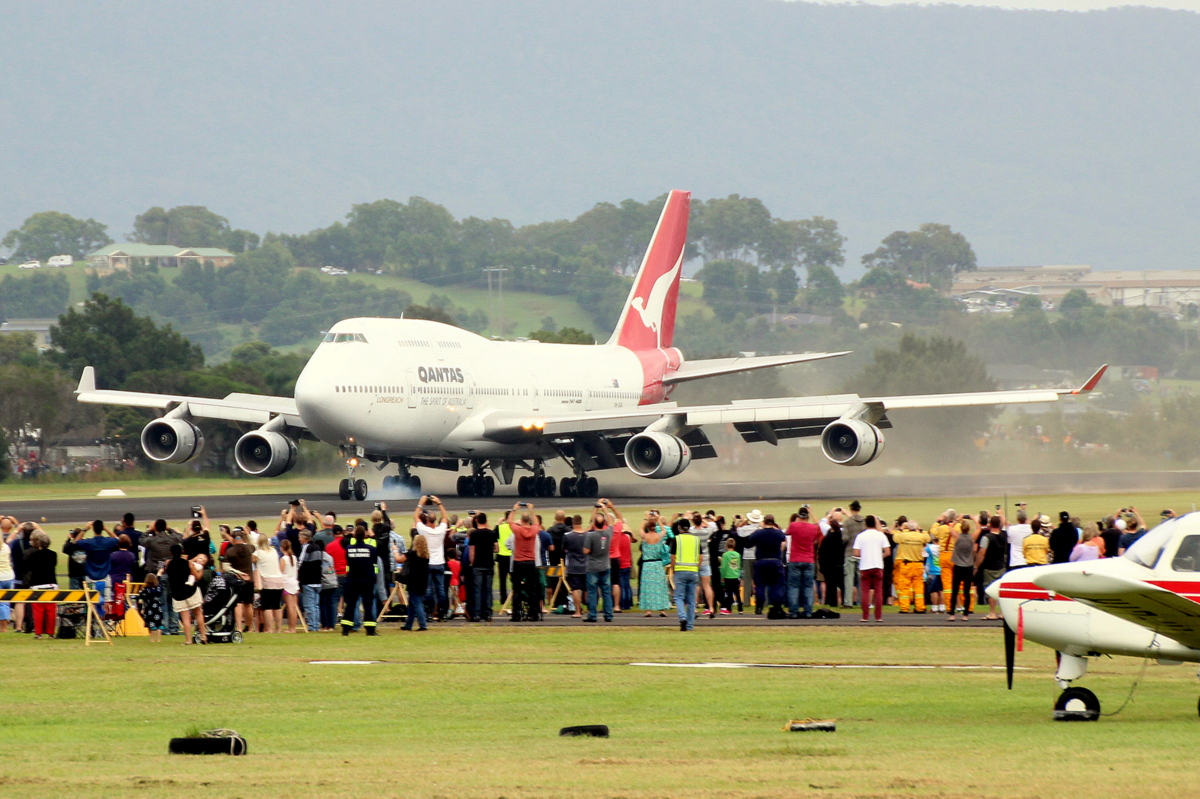
VH-OJA: City of Canberra
Qantas's first 747-400, VH-OJA, made a London - Sydney nonstop delivery flight in 1989 and landed at HARS for preservation on 8 March 2015.
What Boeing supplied, and what the airline chose
Almost everything inside a 747-400 cabin was buyer-furnished and fitted under STC, which is why approved cabin modifications run to dozens.
More in Boeing 747 Family
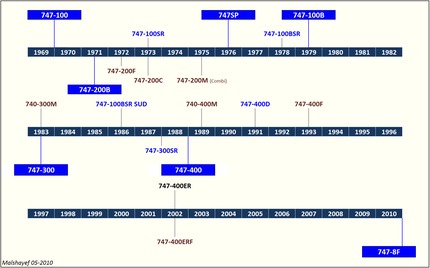
Boeing 747 Family
Every Boeing 747 variant built between 1968 and 2023 - the 747-100, -200, -300, -400 and 747-8, with freighter, combi and short-range models explained.
Boeing 747 Production Data
Download Boeing 747 production totals by generation, with a transparent method and links to Boeing's final programme record and technical documents.
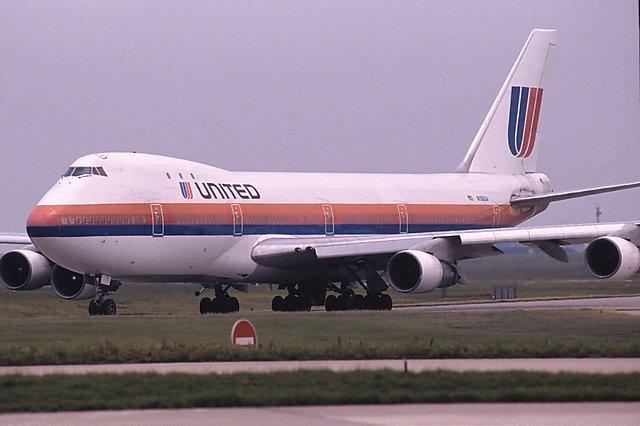
747-100
The original Boeing 747-100 entered service in 1970 with six upper-deck windows and a lounge; later aircraft offered a ten-window upper deck.
747-100B
The 747-100B added a stronger airframe and undercarriage and a 750,000 lb maximum takeoff weight. Only Iran Air and Saudia took delivery.
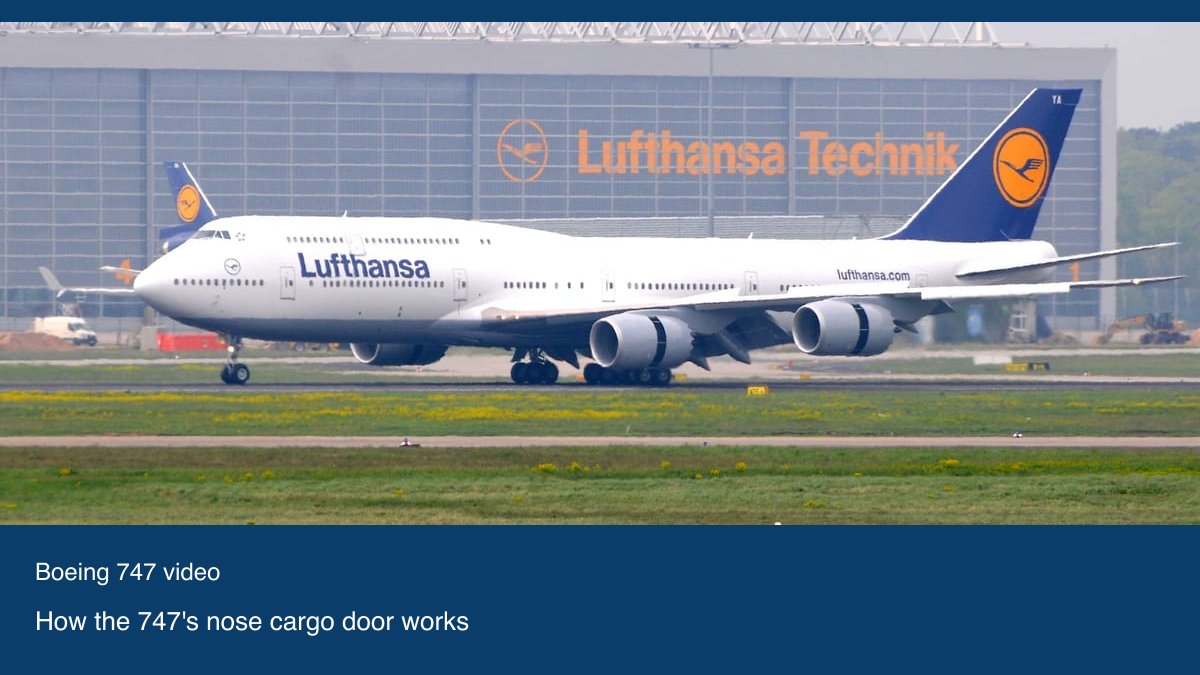
747-100F
Freighter specification for the Boeing 747-100F, covering main-deck and belly cargo volumes, pallet counts and upper-deck crew lounge options.
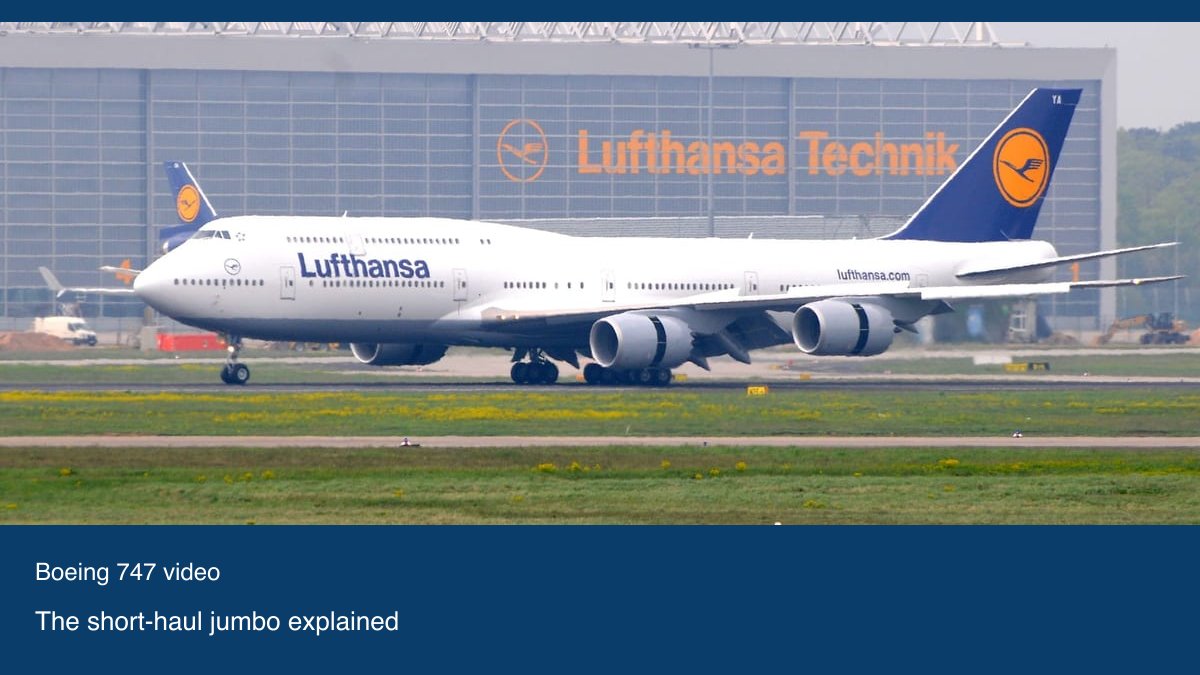
747-100SR
Built for Japanese domestic routes, the 747-100SR traded fuel capacity for seats, carrying up to 550 passengers on short high-frequency sectors.