Boeing 747-8 Forward Cabin: Ceiling and Lighting Concept
Concept rendering of a Boeing 747-8 cabin zone.
Boeing's rendering of the forward cabin zone on the 747-8.
The ceiling that made it feel new
The curve running the length of the ceiling is the clearest inheritance from the 787. On earlier 747s the overhead bins met a flat ceiling panel; here the bins are shaped so the eye reads a continuous arch, which makes a cabin of the same physical width feel larger.
Boeing described the effect as being about perceived space rather than actual space - the 747-8's cross-section is the same one the aircraft has had since 1969. The 787-derived details that carry the illusion through the whole cabin are the curved, suspended bins, the larger windows and the LED lighting:
- Windows are 16 percent larger than the 747-400's - the same size as those on the 777 and 767-400ER - so the arch reads against a brighter, airier backdrop.
- LED lighting replaces fluorescent tubes, capable of setting a cabin mood from sunrise to sunset across a flight, with fewer failures and lower maintenance cost.
Reading the render
This is a concept, not a delivered cabin. Boeing used renderings like this to sell the programme; operational 747-8s vary by airline - seat counts, premium-cabin layout, finishes and even galleys differ from operator to operator. The most detailed public layout is Lufthansa's.
For the rest of the cabin, zone by zone, see the 747-8 interior section.

Sources
Facts on this page are checked against the primary and institutional references below.
Related topics
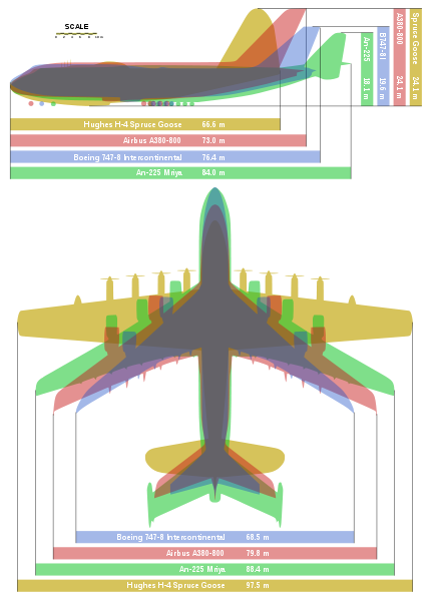
747 versus A380
The two largest airliners ever built, compared - size, capacity, economics, and why both are now out of production.
Boeing 747-400 vs 747-8
The 747-8 is bigger, heavier and quieter than the 747-400, with a new wing, GEnx-2B engines and a stretched fuselage - but it sells a fraction as well.
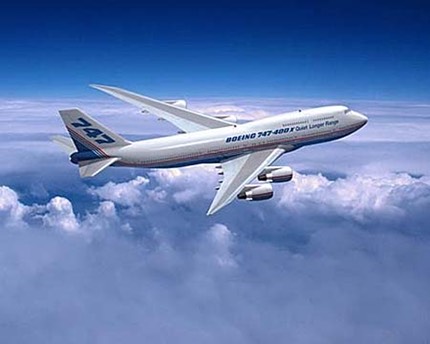
747-400XQLR
Announced at Asian Aerospace 2002, the 747-400XQLR studied quieter, longer-range improvements. It was dropped in favour of the 747-8.
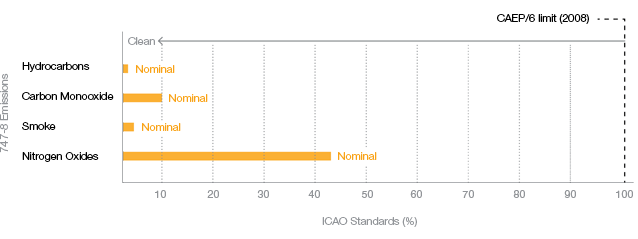
The 747-8 and the environment
The 747-8 meets emissions limits for hydrocarbons, carbon monoxide, smoke and nitrogen oxides, with a noise footprint about 30 percent smaller than the 747-400.
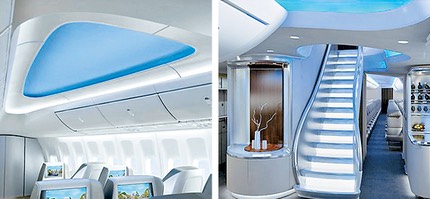
The 747-8 cabin experience
Larger windows, a sculpted 787-style ceiling, LED mood lighting and a quieter cabin than any previous 747.
Boeing 747-8 Intercontinental vs 747-8F
The 747-8I and 747-8F share an engine, a wing and a weight, but split on the upper deck, the nose door and what they are built to haul.
More in Interiors

Inside the 747
How the 747 cabin changed - upper-deck lounges and spiral stairs on the early aircraft, a 787-derived cabin on the last ones.
When the hump was a bar
Piano bars, swivel chairs and spiral staircases - what airlines put in the 747's upper deck before seat counts took it back.
Three staircases
Spiral, straight, then sweeping - the 747's stair to the upper deck changed three times, and each change was about floor area.
First class on the 747
Sleeper seats, upper-deck cabins and lie-flat beds - how the 747 carried the front of the aircraft for fifty years.
Galleys and crew rest
Feeding 400 people and resting the crew that does it - the parts of a 747 cabin passengers never think about.
Boeing 747-8 Interior Guide: Cabin Architecture
The Boeing 747-8 cabin - 787-derived architecture, a curved staircase, larger windows, LED mood lighting and the VIP concepts.