When the 747 tells the crew something is wrong
A 747 carries several independent warning systems that can all trigger at once, so FAA guidance ranks their alerts from reactive windshear at the top to a traffic advisory at the bottom.

A 747 in the 1970s warned the crew with a single master caution light and a set of annunciator panels. A 747-400 warns the crew with a voice, and it may be doing so because of traffic, terrain, weather or the airframe itself - sometimes within the same second. The interesting engineering is not in any one of those systems but in deciding which one gets to speak.
Four levels, and two senses
The regulatory framework is 14 CFR 25.1322, and it sorts alerts into three classes plus a master alert:
- Warning - a condition requiring immediate action.
- Caution - a condition requiring prompt attention.
- Advisory - information for a normal scan.
Warnings and cautions are normally paired with a master visual alert and a master aural alert, so the crew's attention is captured before they start working out what the problem is. Advisories deliberately get neither, because an alert that fires constantly is an alert that stops being read. On the 747, the EICAS is what carries all of this - the master caution and warning lights, the message list, and the aural tones.
Some conditions are too urgent for that treatment. Time-critical warnings - reactive windshear and ground proximity are the named examples - must give the crew immediate awareness without reference to any other display. FAA guidance is specific: each such condition needs a unique voice or unique tone, or both, plus unique visual information in each pilot's primary field of view. The primary flight display is the preferred place for it, because it is where the pilot's eyes already are, which is why its alert vocabulary is written in capital letters: WINDSHEAR, SINK RATE, PULL UP, TERRAIN AHEAD, CLIMB, CLIMB. Time-critical text and graphics must be red, and the alert is cleared once the condition no longer exists.
TCAS: advice, then instruction
TCAS II interrogates the transponders of nearby aircraft and computes whether they threaten to enter a protected volume around the 747. It produces two kinds of output:
| Output | What it means | Timing |
|---|---|---|
| Traffic advisory | A nearby aircraft is a potential threat; look outside | Roughly 20 - 48 seconds to closest point of approach |
| Resolution advisory | Fly this vertical manoeuvre | Roughly 15 - 35 seconds to closest point of approach |
The ranges depend on the selected sensitivity level. Two limitations are worth stating plainly, because they are often assumed away. First, TCAS is explicitly "a supplement to the pilot who has the primary responsibility" - it does not relieve the crew of anything, and it gives no indication of an aircraft without an operative transponder. Second, resolution advisories can only be generated for intruders that report their altitude, which requires a responding Mode S or Mode C transponder. Traffic advisories are broader: any aircraft with an operative Mode S, Mode C or Mode A transponder can generate one.
A Mode S transponder is therefore mandatory for TCAS II, doing double duty as the air-to-air data link that lets two aircraft coordinate their resolution manoeuvres so that one is not told to climb while the other is told to descend.
Current software, version 7.1, adds hybrid surveillance: the transponder broadcasts its own position rather than the system needing to interrogate it directly, which measurably reduces congestion on the 1090 MHz frequency. Modern installations also inhibit the system near the ground - below 1,100 ft on climb and 900 ft on descent - reverting to traffic advisory only.
Terrain, and the alert that beats everything
Terrain awareness, known through most of its service life as EGPWS and before that as GPWS, is the system that grew out of accidents where a perfectly serviceable 747 flew into the ground with no idea it existed. It fuses radio altitude, groundspeed and an onboard terrain database to give enGPWS-style alerts, and on later standards predictive information about the terrain ahead.
Its alerts are drawn from a wide vocabulary, and each one is individually scheduled: excessive sink rate, excessive closure rate to terrain, terrain awareness pull-up, too low terrain, too low flaps, don't sink, excessive glideslope deviation, and the voice callouts for bank angle, minimums and approaching minimums.
Windshear systems divide the same way. Reactive windshear detection is driven by the abrupt change in airspeed as the aircraft flies through the shear; predictive windshear uses the on-board weather radar to spot the microburst ahead. FAA guidance for the warning threshold is grounded in performance rather than arbitrary values: warning threshold values in excess of a 15% loss of climb gradient are treated as too late to act on, and the guidance recommends a variable, altitude-programmable threshold that becomes more sensitive as altitude decreases, because a fixed threshold that works at 1,000 ft does not leave enough room to go around at 200 ft.
The priority scheme
Here is the problem all of that creates. A 747 on a windshear encounter in cloud near rising terrain with traffic nearby can generate half a dozen alerts at once. The approved guidance therefore ranks every alert from highest to lowest, and the ordering is not negotiable at the flight crew's discretion:
| Priority | Alert |
|---|---|
| 1 | Reactive windshear warning |
| 2 | Sink rate pull-up |
| 3 | Terrain closure pull-up |
| 4 | Terrain awareness pull-up |
| 5 | Predictive windshear warning |
| 6 | Minimums voice callouts |
| 7 - 15 | Terrain awareness caution, too low terrain, too low flaps, sink rate, don't sink, glideslope |
| 16 - 19 | Predictive windshear caution, approaching minimums, bank angle, reactive windshear caution |
| 20 | TCAS resolution advisory |
| 21 | TCAS traffic advisory |
TCAS sits at the bottom deliberately. When terrain or windshear warnings fire, TCAS automatically reverts to traffic advisory only, so its resolution advisory is suppressed - a climb instruction from a traffic system is not allowed to compete with an instruction to pull up.
Stall protection
The same philosophy covers the oldest warning on the aeroplane. Stall warning is a required item under 14 CFR 25.207, and the 747's stall warning is deliberately tactile as well as aural: the control column shaker is designed to be impossible to ignore, and the alerting guidance's two-sense principle is aimed at exactly this class of warning.
Related
- EICAS - the system that displays and sounds most of these alerts
- Navigation and avionics - the transponders and radio navigation feeding them
- Weather radar - the predictive windshear and terrain picture
- Flight recorders - what they captured afterwards
Frequently asked questions
- What is the difference between a warning, a caution and an advisory?
- A warning demands immediate action, a caution demands prompt attention, and an advisory is information the crew should see in the course of a normal scan. Warnings and cautions are typically accompanied by a master visual and aural alert; advisories are not, because they do not require immediate awareness.
- What happens if TCAS and terrain awareness both alert at the same time?
- The systems are prioritised. Terrain awareness and windshear alerts take precedence, and TCAS automatically reverts to traffic advisory only, suppressing its resolution advisory. The approved guidance sets out a full ranking of all twenty-one alert types for exactly this case.
- Does TCAS prevent collisions?
- No. It is a supplement to the pilot, who retains primary responsibility for avoiding other aircraft. It gives no indication at all of an aircraft without an operative transponder, and resolution advisories can only be generated for intruders that report their altitude.
Sources
Facts on this page are checked against the primary and institutional references below.
- AC 25.1322-1 - Flightcrew Alerting - US Federal Aviation Administration
- AC 20-151B - Airworthiness Approval of Traffic Alert and Collision Avoidance Systems (TCAS II) - US Federal Aviation Administration
- AC 25-12 - Airworthiness Criteria for the Approval of Airborne Windshear Warning Systems - US Federal Aviation Administration
- Airworthiness Criteria for the Installation Approval of a Terrain Awareness and Warning System - US Government Publishing Office
- Supplement to Boeing/FAA Approved MMEL for Boeing 747-400 - UK Civil Aviation Authority
Related topics
Boeing 747: History, Variants and Legacy
A complete reference to the Boeing 747, built from 1968 to 2023 - every variant from the 747-100 to the 747-8, plus special-mission jumbos and photos.
Boeing 747 Family
Every Boeing 747 variant built between 1968 and 2023 - the 747-100, -200, -300, -400 and 747-8, with freighter, combi and short-range models explained.
Boeing 747 Production Data
Download Boeing 747 production totals by generation, with a transparent method and links to Boeing's final programme record and technical documents.
The 747 Combi and the fire rule that caught up with it
The 747 Combi carried passengers and freight on one deck under 1940s-era fire rules. After South African Airways Flight 295, those rules were rewritten.
Maintaining a 747
Line checks, A checks, C checks and the D check - how a 747 is kept airworthy, and why maintenance decides when an aircraft is retired.
The Boeing 747 History Quiz
A 10-question Boeing 747 history quiz covering the launch airlines, the engineers who built the jumbo, and the bestsellers of the family.
More in Aircraft Systems
How the 747 works
The systems that make a 747 fly - fuel, hydraulics, landing gear, electrics and pressurisation, explained one at a time.
Boeing 747 specifications compared
Compare Boeing 747 dimensions, performance and detailed later-variant weights, fuel and cargo capacities, with Boeing planning configurations identified.
Boeing 747 Freighter Specifications
Compare Boeing 747-400F, 747-400ERF and 747-8F weights, structural payload, fuel and cargo volumes using identified Boeing planning configurations.
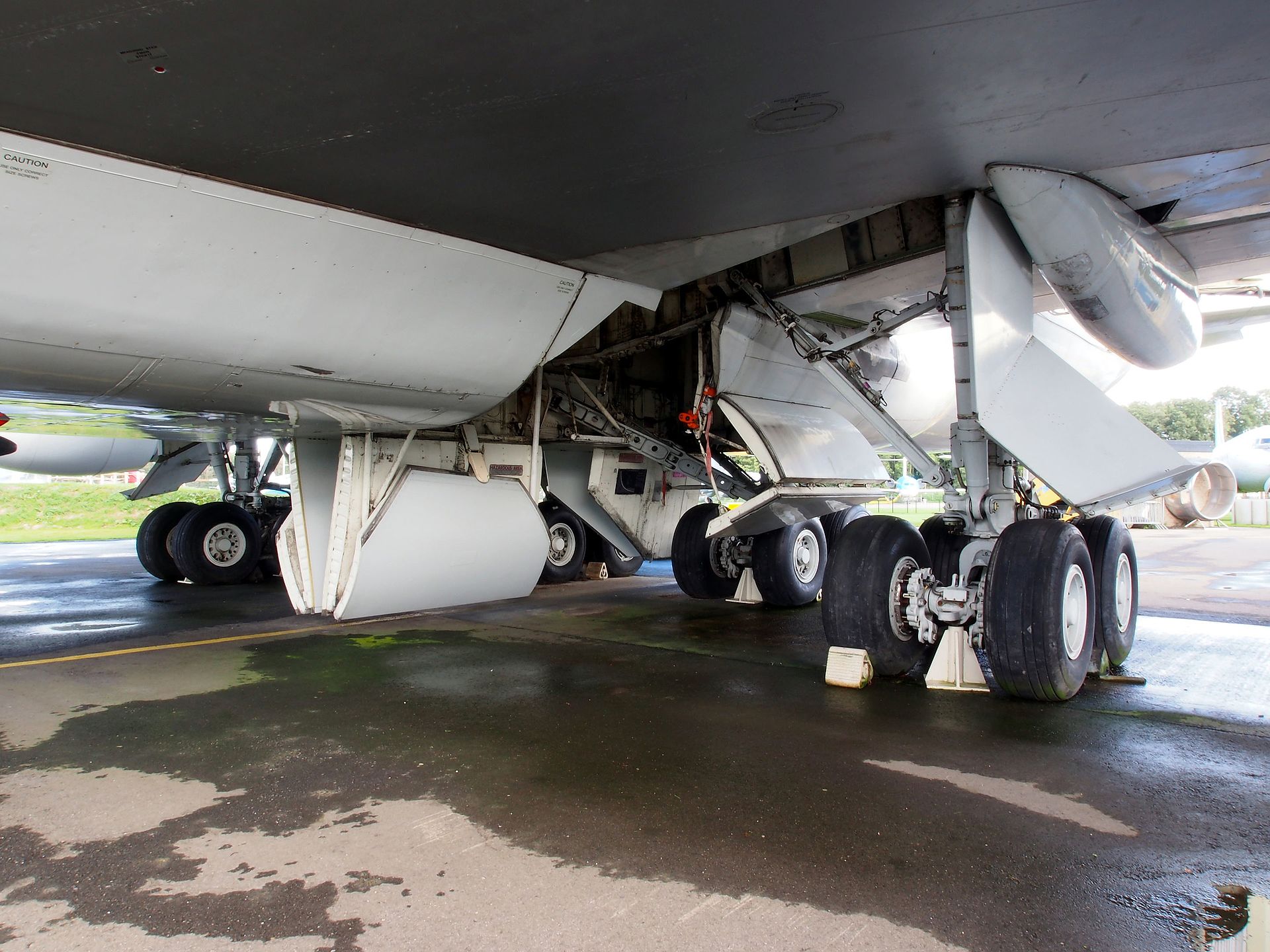
The four hydraulic systems
The 747 has four independent hydraulic systems, one per engine, each with a backup pump - and the reasoning behind splitting them that way.
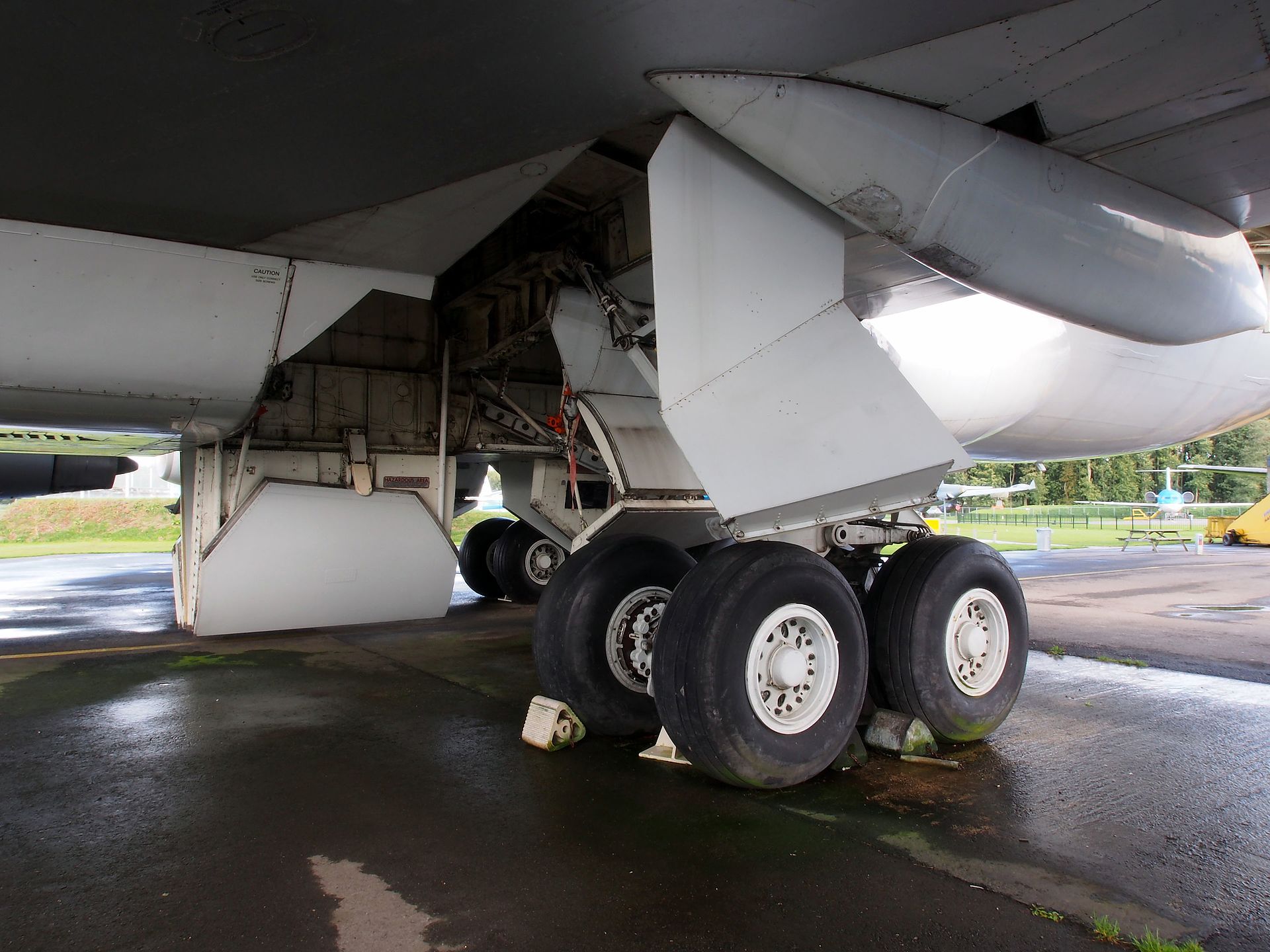
Eighteen wheels
The 747's five landing gear legs and 18 tyres, why the load is spread that way, and the body gear steering that stops it tearing up taxiways.
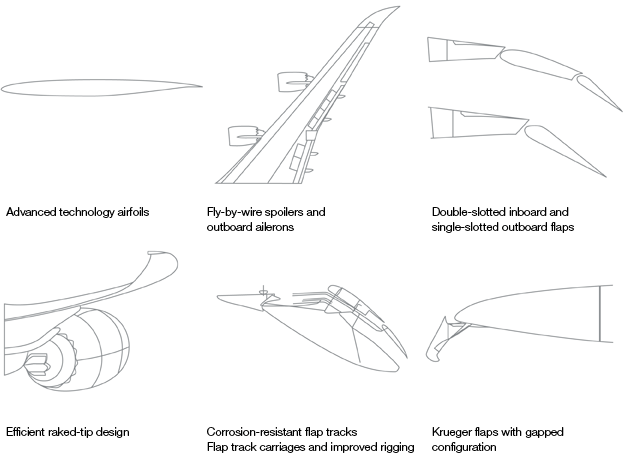
Flight controls and high-lift devices
How a 747 is flown - split ailerons, spoilers, triple-slotted flaps and Krueger leading edge devices, and what the 747-8 changed.