The system that decides where the fuel goes
Operator-specific weight and balance data, the cargo compartment load limits, and the position rules that decide which unit load devices may be loaded where on the main deck.
Some of the most consequential systems on a 747 are not on the aeroplane at all. Every operator holds its own weight and balance control and loading manual, and on a freighter that document decides which pallets may be placed where - and therefore what a given load actually earns.
Every operator's manual is different
A 747 weight and balance manual is not a Boeing document sold off the shelf. It is written for a specific fleet, and it has to be. The regulations require the data to exist in a form that establishes the aircraft's weight and balance requirements and allowables, organised to an industry standard - the ATA Specification No. 100, Specification for Manufacturers' Technical Data.
Its structure is worth knowing, because it explains why the manual is so long:
| Part | Contains |
|---|---|
| Chapter 1 - Control | Weight and balance data specific to the operator's own aircraft, in modular subject packages |
| Chapter 2 - Aircraft Reports | For each delivered aircraft: make, model, serial number, registration, actual weighing data, and the inventory list for its delivery configuration |
Chapter 1 uses three-element chapter-section-subject numbers, so that fuel data sits in the 20-to-29 series and other topics each get their own block. Chapter 2 is the part that dates quickly: it is a snapshot of each individual airframe as delivered, including what was fitted. Change the seats, the entertainment, the galleys or the crew rest, and the aircraft's empty weight and centre of gravity move.
The weight vocabulary
The airport-planning documentation defines the envelope, and these definitions are the frame for every performance figure the type has ever published:
| Term | Meaning |
|---|---|
| OEW | Operating empty weight - structure, powerplant, furnishings, unusable fuel, crew and equipment, excluding usable fuel and payload |
| MZFW | Maximum design zero fuel weight - the maximum weight before usable fuel is loaded |
| MTOW / MLW / MTW | Maximum design takeoff, landing and taxi weights |
| Maximum payload | MZFW minus OEW |
| Usable fuel | Fuel available for propulsion |
The relationship between the middle two is the one that shapes every 747 flight. Payload is not independent of fuel. Because payload is derived from zero fuel weight, carrying more fuel necessarily reduces what can be carried, which is why a freighter's revenue payload depends on how far the aircraft is going and how much it must divert.
Loading limits are not uniform
For a freighter or Combi, the manual's cargo compartment load limits section is where the real engineering sits. It is organised into distinct categories, and the categories are not interchangeable:
- Maximum allowable weights for the upper deck, main deck and lower deck separately - the ceilings the basic monocoque can sustain.
- Maximum combined linear load limits.
- Main deck unsymmetrical payload linear load limits - because an off-centre load is more demanding than the same weight spread evenly.
- Main deck centreline load limits.
- Allowable main deck running load versus centre wing tank fuel - the interaction between cargo on the floor and fuel in the wing box directly above it.
That last item is the one that surprises people. A 747's main deck cargo sits beneath the centre wing section, and the loading limits for that area are expressed as a function of how much fuel is in the centre wing tanks. A full main deck and full centre wing tanks are not independent choices.
Position rules, at bulkhead stations
The freighter's main deck is not an empty box that accepts pallets in any order. The loading manual restricts which unit load devices may go where, and it expresses those positions at bulkhead stations - fixed reference points along the fuselage. The rules are strictly directional:
- Laterally forward of one station, only the smallest pallet size codes may be used.
- Longitudinally forward of that same station, a wider set of codes is permitted.
- Aft of a much later station, a different set again is allowed.
- Containers forward of an earlier station are height-limited, specifically to guarantee clearance above the load so that air can circulate around the containers for decompression and smoke detection.
That last rule is a fire protection requirement expressed as a loading instruction. The cargo hold is smoke-detected - see the fire detection and extinguishing page - and smoke detection only works if air can move. A container stacked flush to the ceiling would defeat it.
The freighter's cargo-loading system exists to serve this: the nose door swings up and pallets and containers up to 40 ft are rolled straight in on motor-driven rollers, and the operator's loading manual then decides the order.
Restraint is the part that cannot be improvised
The minimum equipment list permits a cargo restraint system to be inoperative or missing on a conditional basis: the compartment may still be operated provided acceptable cargo loading limits from an approved source - an Approved Cargo Loading Manual, Cargo Handling Manual, or Weight and Balance Manual - are observed. Otherwise it must remain empty.
The condition is the point. Restraint systems are what make an off-centre load survivable, and the relief is permitted only because a lower limit is imposed instead. This is the same pattern as the hydraulic systems and the flight controls: the primary protection may be deferred, but never without a documented substitute.
Where the -400ER breaks the pattern
The 747-400ER can carry up to two 3,060 US gallon tanks in the forward lower cargo compartment, as the planning documentation notes. Those tanks only exist because that space was no longer needed for cargo - and the 747-400ERF, with its greater cargo capacity, is specifically not fitted with them.
So the aeroplane with the most fuel capacity in the -400 family is also the one whose forward hold is spoken for, and the weight and balance manual is what reconciles the fuel system configuration, the loading plan and the payload for each individual departure.
Related
- Cargo-loading system - how the freight gets aboard
- Fuel system - the other half of the loading calculation
- The 747-400ER - the variant whose hold became a fuel tank
- Fire detection and extinguishing - why airflow above the cargo matters
Frequently asked questions
- What is maximum zero fuel weight on a 747?
- The maximum weight allowed before usable fuel and other specified usable agents are loaded, limited by structural strength and airworthiness requirements. Maximum payload is derived from it by subtracting operating empty weight, which means payload is a function of how much fuel is being carried and therefore where the aeroplane can be loaded.
- Why can a 747 freighter not just load pallets anywhere?
- Because the structure is not uniform and the loading must stay within published linear load limits. The main deck has position-specific restrictions expressed at bulkhead stations, and containers forward of one station are height-limited to leave clearance for airflow around them for decompression and smoke detection.
- What happens if the cargo restraint system fails on a 747?
- The compartment may still be operated, provided acceptable cargo loading limits from an approved source - an Approved Cargo Loading Manual, Cargo Handling Manual or Weight and Balance Manual - are observed. Alternatively it must remain empty. This is a deferrable item, and the relief is conditional precisely because the restraint system is what makes an unbalanced load survivable.
Sources
Facts on this page are checked against the primary and institutional references below.
- Weight and Balance Control and Loading Manual, Model 747-440 - Boeing, reproduced in an NTSB docket
- 747-400 Airplane Characteristics for Airport Planning - Boeing
- Supplement to Boeing/FAA Approved MMEL for Boeing 747-400 - UK Civil Aviation Authority
Related topics
Boeing 747: History, Variants and Legacy
A complete reference to the Boeing 747, built from 1968 to 2023 - every variant from the 747-100 to the 747-8, plus special-mission jumbos and photos.
Boeing 747 Family
Every Boeing 747 variant built between 1968 and 2023 - the 747-100, -200, -300, -400 and 747-8, with freighter, combi and short-range models explained.
Boeing 747 Production Data
Download Boeing 747 production totals by generation, with a transparent method and links to Boeing's final programme record and technical documents.
The 747 Combi and the fire rule that caught up with it
The 747 Combi carried passengers and freight on one deck under 1940s-era fire rules. After South African Airways Flight 295, those rules were rewritten.
Maintaining a 747
Line checks, A checks, C checks and the D check - how a 747 is kept airworthy, and why maintenance decides when an aircraft is retired.
The Boeing 747 History Quiz
A 10-question Boeing 747 history quiz covering the launch airlines, the engineers who built the jumbo, and the bestsellers of the family.
More in Aircraft Systems
How the 747 works
The systems that make a 747 fly - fuel, hydraulics, landing gear, electrics and pressurisation, explained one at a time.
Boeing 747 specifications compared
Compare Boeing 747 dimensions, performance and detailed later-variant weights, fuel and cargo capacities, with Boeing planning configurations identified.
Boeing 747 Freighter Specifications
Compare Boeing 747-400F, 747-400ERF and 747-8F weights, structural payload, fuel and cargo volumes using identified Boeing planning configurations.
The four hydraulic systems
The 747 has four independent hydraulic systems, one per engine, each with a backup pump - and the reasoning behind splitting them that way.
Eighteen wheels
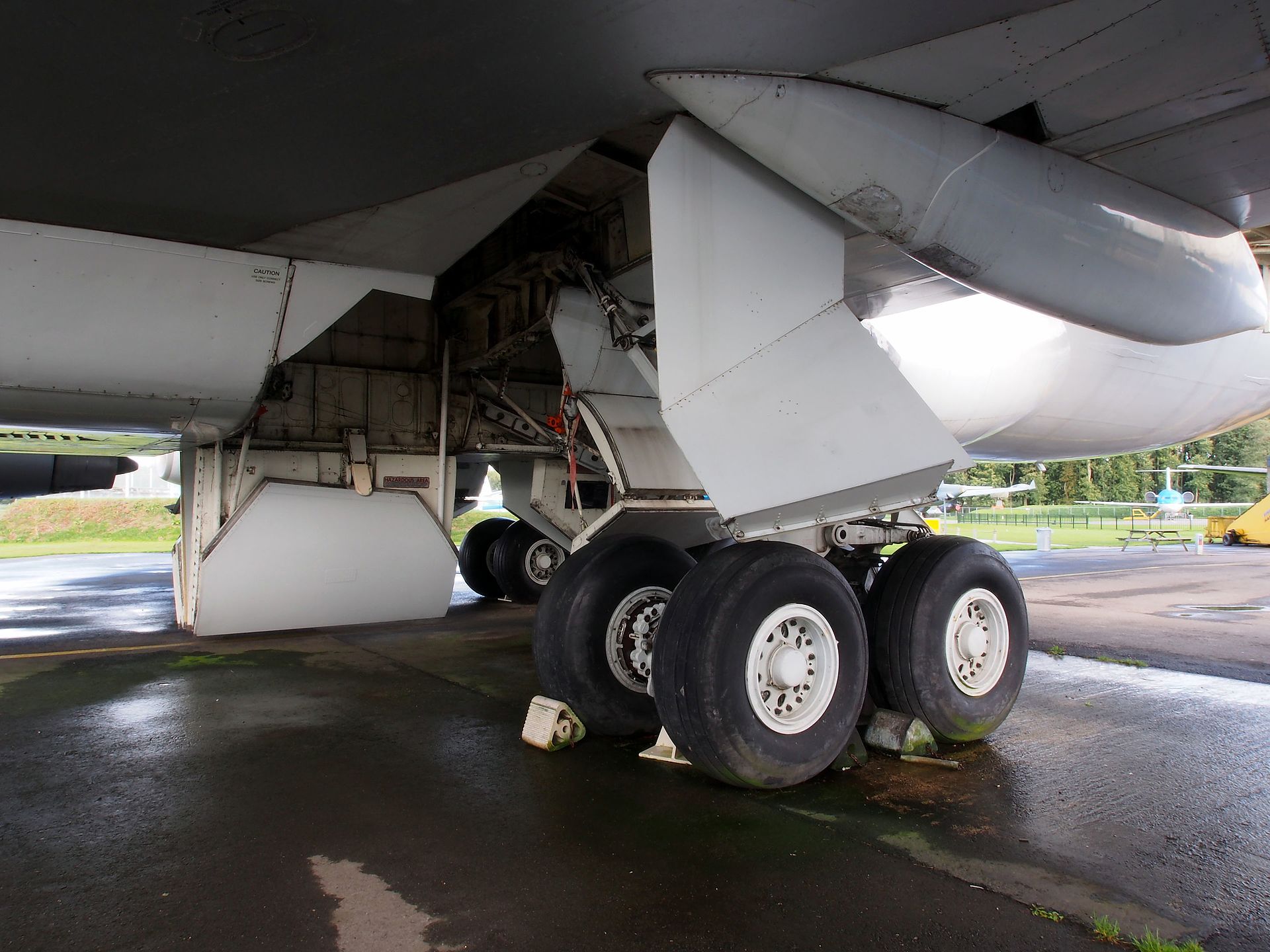
The 747's five landing gear legs and 18 tyres, why the load is spread that way, and the body gear steering that stops it tearing up taxiways.
Flight controls and high-lift devices
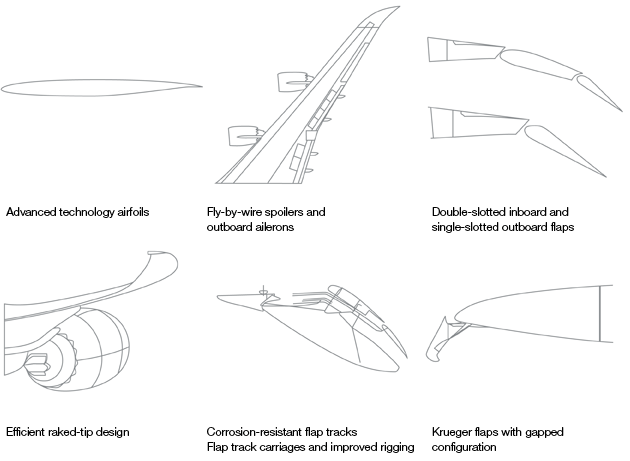
How a 747 is flown - split ailerons, spoilers, triple-slotted flaps and Krueger leading edge devices, and what the 747-8 changed.